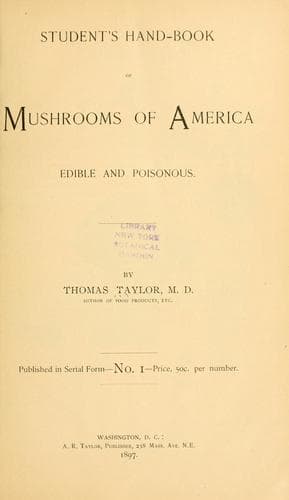
Student's Hand-book of Mushrooms of America, Edible and PoisonousTaylor, Thomas
Science
Student's Hand-book of Mushrooms of America, Edible and Poisonous
Taylor, Thomas
Mushrooms -- United States; Pathogenic fungi
Cap bell-shaped or ovate at first, then expanded, smooth, obtuse,
viscid, margin even, creamy-white, brown, or greenish, without warts;
flesh white; stem white, hollow or stuffed, bulbous at the base,
annulate; gills rounded and ventricose, coarse, and persistently white,
free from the stem; volva conspicuous, large, loose, adhering to the
base, but free from the stem at the top, with the margin irregularly
notched. In the white forms there is frequently a greenish or yellow
tinge at the disk or centre of the cap. The white form is most common,
but the brownish is often found in this country. I have not yet found
the green-capped variety sometimes figured in European works. In the
brown variety the stem and ring are often tinged with brown, as also the
volva. The cap is usually from 2 to 3 inches broad, and the stem from 3
to 5 inches long. The whole plant is symmetrical in shape and clean
looking, though somewhat clammy to the touch when moist. It is very
common in mixed woods, in some localities, and is universally considered
as fatally poisonous.
The white form of A. _phalloides_, although in reality bearing very
little resemblance to the common field mushroom, has been mistaken for
it as also for the _Smooth white lepiota_, and in some instances has
been eaten with fatal results by those who gathered it.
The distinction between this most poisonous Amanita and the common field
mushroom is well marked. In the common mushroom the _gills_ are _pink,
becoming dark brown_, the _spores purplish brown_, and the whole
mushroom is stout and short stemmed, the stem being shorter than the
diameter of the cap, and having no volva, or wrapper at its base. In the
species A. _phalloides_ the _gills_ are _persistently white_ and the
bulb is distinct and broad at the base, the white cup-shaped wrapper
sheathing the base of the stem like the calyx of a flower. The _Smooth
white lepiota_ shows neither volva nor trace of one, and has other
distinct characteristics which distinguish it from A. _phalloides_. See
page 14, No. 4 of this series.
The specimen figured in Plate XV grew in Maryland, where it is quite
common.
PLATE XV.
FIG. 9.--=Ag. (Amanita) mappa (Amanita mappa)= Linn., =Amanita
citrina=, =A. virosa.=
POISONOUS.
Cap at first convex, then expanded, dry, without a separable cuticle,
not warty but showing white, yellowish, or brownish scales or patches on
its upper surface; gills white, adnexed; flesh white, sometimes slightly
yellowish under the skin; stem stuffed, then hollow, cylindrical,
yellowish white, nearly smooth, with a distinctly bulbous base; volva
white or brownish. Odor pleasant. Spores spheroidal. The cap in this
species is somewhat variable in color, but those having a white cap are
most common. The plant is not so tall as those of the species
_phalloides_. It is solitary in habit, and is found usually in open
woods.
Curtis and Lowerby figure _mappa_ and _phalloides_ under the same name.
Public-domain text, read in full here on John Shaqi.
Reviews
Reviews
No reviews yet
Be the first to share your thoughts on this work.
Elsewhere in the archive
Join the Discussion
Join the discussion
Sign in to leave a comment or review.
Sign InorCreate an account