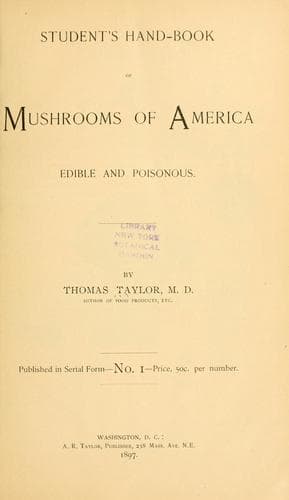
Student's Hand-book of Mushrooms of America, Edible and PoisonousTaylor, Thomas
Science
Student's Hand-book of Mushrooms of America, Edible and Poisonous
Taylor, Thomas
Mushrooms -- United States; Pathogenic fungi
The toxic alkaloid of Amanita _phalloides_ Fries (Amanita _bulbosa_) was
examined by Boudier, who named it "_bulbosin_," and by Ore, who named it
"_phalloidin_," but their examinations, it is claimed, proved little
beyond the fact that it seemed to be in the nature of an alkaloid,
identical neither with _muscarin_ nor _helvellic_ acid.
Ore affirmed that the _phalloidin_ of the Amanita phalloides was very
nearly related to, and perhaps identical with, strychnine. From this
view Kobert and others dissent.
The poisonous principle of Amanita _phalloides_ has recently been
subjected to very careful analysis by Prof. Kobert. As a result of a
large number of experiments and post-mortem examinations held on persons
poisoned by A. _phalloides_, Kobert states that the symptoms can be
explained uniformly by the action of a poison, to which he gives the
provisional name of "_phallin_." This is an albuminous substance which
dissolves the corpuscles of the blood, resembling in this and other
respects in a remarkable degree the action of _helvellic_ acid.
According to Kobert _phallin_ has so far only been found in Amanita
_phalloides_ and in its varieties _verna_, _mappa_, etc. He finds also
in this mushroom muscarin and an atropin-like alkaloid.
The symptoms of the phalloides poisoning are complex. Vomiting is
accompanied by diarrhoea, cold sweats, fainting at times, convulsions,
ending in coma. There is also fever and a quickening of the pulse. All
these symptoms, which follow in succession, according to one author, are
dependent on two different poisonous substances. The first may be an
acrid and fixed poison, for it is found after repeated dryings, as well
in the aqueous as in the alcoholic extract. The second acts by
absorption, and is purely narcotic.
Phallin has some of the properties of the toxalbumin of poisonous
spiders, and is a vegetable toxalbumin.
It has been remarked that in cases of poisoning by A. _phalloides_, the
mushroom has tasted very good, and those poisoned felt well for several
hours after eating.
Phalloides poisoning is said to bear a marked resemblance to phosphorus
poisoning and to acute jaundice. There is no known antidote to the
poisonous alkaloid _phallin_.
According to Prof. Kobert's analyses, the proportion of phallin in the
dried mushroom amounts to less than 1%, but its effect on account of its
concentration is the more intensive.
Extensive experiments made by Kobert with ox blood in regard to the
comparative action of different substances in their power of dissolving
the red blood corpuscles demonstrate that _phallin_ in this respect
exceeds all known substances. Kobert states that "If _phallin_ be added
to a mixture of blood with a 1% solution of common salt, using the blood
of man, cattle, dogs, or pigeons, the blood corpuscles will be entirely
dissolved by the poison diluted to 1-125,000."
Public-domain text, read in full here on John Shaqi.
Reviews
Reviews
No reviews yet
Be the first to share your thoughts on this work.
Elsewhere in the archive
Join the Discussion
Join the discussion
Sign in to leave a comment or review.
Sign InorCreate an account