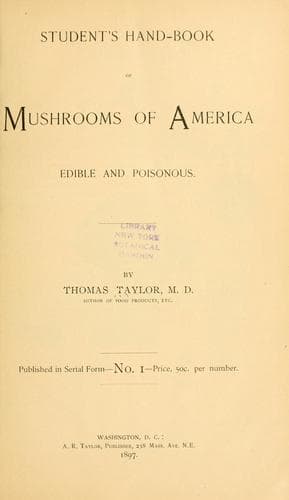
Student's Hand-book of Mushrooms of America, Edible and PoisonousTaylor, Thomas
Science
Student's Hand-book of Mushrooms of America, Edible and Poisonous
Taylor, Thomas
Mushrooms -- United States; Pathogenic fungi
Prof. Kobert states that he has examined the species Boletus edulis,
Agaricus campester, and Amanita Caesarea a number of times, but could
never detect the action of phallin in them. Neither has he found it in
A. muscaria.
THE POISONOUS ALKALOID OF GYROMITRA ESCULENTA FRIES (HELVELLA ESCULENTA
PERS.)
HELVELLIC ACID.
Prof. Kobert writes of a number of cases of poisoning in the Baltic
provinces of Russia by the mushroom Helvella _esculenta_ Persoon,
sometimes called the Lorchel. It should be here stated that the
_Helvella esculenta_ of Persoon is the _Gyromitra esculenta_ of Fries.
This mushroom is described as edible and placed in the edible lists by
Dr. M. C. Cooke, Prof. Peck, and other distinguished mycologists, who
have tested it and found it edible when perfectly fresh.
The poisonous principle of this mushroom was isolated and analyzed by
Prof. R. Boehm, of Russia, in 1885. It was by him designated as
"_helvellic acid_," and found to be soluble in hot water. Profs. Eugene
Bostroem and E. Ponfick, after giving some study to the effects of this
mushroom poison, agreed in their report concerning it, which is to the
effect that the _quickly dried_ H. _esculenta_ (Gyromitra _esculenta_)
is not poisonous, and that the poisonous acid of the fresh ones may be
extracted by means of hot water, so that while the decoction is
poisonous the mushroom is not at all so, after the liquid is pressed
out. Experiments with this mushroom were made by both authors on dogs,
which ate them greedily, but without exception the dogs were very sick
afterwards. The symptoms were nausea, vomiting, jaundice, stoppage of
the kidneys, and haemaglobinuria. The symptoms observed in man correspond
to those manifested by the lower animals. Dissection showed the
dissolution of innumerable blood corpuscles.
Prof. Kobert, commenting on the experiments made by Bostroem and
Ponfick, states that he himself had been furnished yearly with fresh
specimens of "H. _esculenta_" (G. _esculenta_) specially gathered for
him at Dorpat, and after making various experiments with the freshly
expressed juice he became convinced that the poisonous principle greatly
varies, the juice sometimes operating as very poisonous, and sometimes
as only slightly so. He states also that the proportion of poison in the
mushroom varies with the weather, location, and age of the mushroom. The
inhabitants of Russia do not eat this mushroom, but in Germany it is
eaten dried or when perfectly fresh, after cooking, and after the first
water in which it is boiled is removed.
Helvellic acid is not found in Morchella _esculenta_ (the true Morel),
nor is it known to exist in any other species except G. _esculenta_. It
has been stated that there is no antidote for helvellic poisoning after
the symptoms have appeared.
Public-domain text, read in full here on John Shaqi.
Reviews
Reviews
No reviews yet
Be the first to share your thoughts on this work.
Elsewhere in the archive
Join the Discussion
Join the discussion
Sign in to leave a comment or review.
Sign InorCreate an account