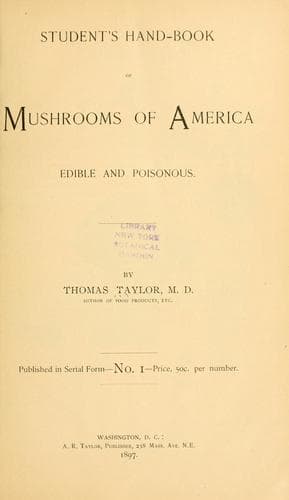
Student's Hand-book of Mushrooms of America, Edible and PoisonousTaylor, Thomas
Science
Student's Hand-book of Mushrooms of America, Edible and Poisonous
Taylor, Thomas
Mushrooms -- United States; Pathogenic fungi
These shades are somewhat different from the colors of the mushrooms'
gills, so that, when it is of importance to determine exactly the color
of the spore in the identification of a species, we may without recourse
to the microscope cut off the stem of an adult plant on a level with the
gills and place the under surface of the cap upon a leaf of white paper
if a dark-spored species, and upon a sheet of black paper if the spores
are light. At the expiration of a few hours we will find, on lifting the
cap, a bed of the shed spores which will represent their exact shade.
These may be removed to a glass slide and their size and form determined
by means of the microscope.
In the present work Dr. M. C. Cooke's grouping of the spore series is
adopted.
ETYMOLOGY OF THE WORD "MUSHROOM."
Various opinions have been offered as to the derivation of the word
"mushroom." According to Hay, it probably had its origin in a
combination of the two Welsh words _maes_, a field, and _rhum_, a knob,
which by gradual corruption have become _mushroom_. Some writers on the
other hand regard it as a corruption of _mousseron_, a name specifically
applied by the French to those mushrooms which are found growing in
mossy places. But it seems to be of older usage than such a derivation
would imply, and therefore the first explanation seems the more likely
to be correct.
In England the term "mushroom" has been most commonly applied to the
"meadow mushroom," that being the one best known; but English-speaking
mycologists now apply it generically very much as the French do the term
"champignon," while the name "champignon" is restricted in England to
the Marasmius oreades, or "Fairy Ring" mushroom.
Berkeley says the French word "champignon" was originally scarcely of
wider signification than our word "mushroom," though now classical in
the sense of fleshy fungi generally. The German word _Pilz_ (a
corruption of Boletus) is used to denote the softer kinds by some German
authors. Constant and Dufour, in their recently published Atlas des
Champignons, include types of a great variety of mushrooms.
Hay contends that the pernicious nick-name "toad-stool" has not the
derivation supposed, but that the first part of the word is the Saxon or
old English "tod," meaning a bunch, cluster, or bush, the form of many
terrestrial fungi suggesting it. The second syllable, "stool," is easily
supplied. "The erroneous idea of connecting toads with these plants,"
says Hay, "seems to be due to Spenser, or to some poet, possibly, before
his time." Spenser speaks of the loathed paddocks, "paddock" then being
the name given in England to the frog, afterwards corrupted to "paddic,"
and once received, readily converted by the Scotch into "puddick-stool."
It would seem, therefore, from the foregoing, that the term "toad-stool"
can have no proper relation to mushrooms, whether edible or poisonous.
Public-domain text, read in full here on John Shaqi.
Reviews
Reviews
No reviews yet
Be the first to share your thoughts on this work.
Join the Discussion
Join the discussion
Sign in to leave a comment or review.
Sign InorCreate an account