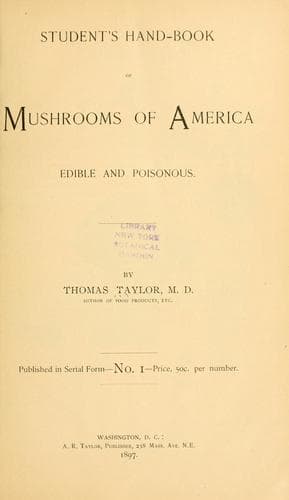
Student's Hand-book of Mushrooms of America, Edible and PoisonousTaylor, Thomas
Science
Student's Hand-book of Mushrooms of America, Edible and Poisonous
Taylor, Thomas
Mushrooms -- United States; Pathogenic fungi
The geographical distribution of many species of the mushroom family is
very wide. We have had specimens of the _Morel_, for instance, sent to
us from California and Washington, on the Pacific coast, and as far
north as Maine, on the Atlantic, as well as from the southern and the
midwestern States, and the same is true of other species. The season of
their appearance varies somewhat according to the latitude and altitude
of place of growth. Mushrooms are rarely seen after the first heavy
frosts, although an exception is noted in this latitude in the species
Hypholoma sublatertium, which has been found growing under the snow, at
the roots of trees in sheltered woods. Frozen mushrooms of this and
closely allied species have revived when thawed, and proved quite
palatable when cooked.
At the present time only two species, Agaricus campester and Agaricus
arvensis, are cultivated in America. Some attempts have been made by an
amateur mushroom club in Ohio to cultivate the Morel, but the results
have not, so far, been reported. In the meantime, however, it is well to
utilize the wild mushrooms as fast as the collector can satisfactorily
identify them. The woods of all moist regions of this country abound
with edible varieties. Prof. Curtis, of North Carolina, gives a list of
over one hundred edible species found in that State alone, and nearly
all of these occur in our Northern States as well. It is not contended
that this list includes all the species which may be eaten, nor have all
of these equal value from a gastronomic point of view. Some are insipid
as to flavor, and others are too tough or too slimy to please the
popular taste.
CAUTIONARY SUGGESTIONS.
Before collecting for the table mushrooms found growing in the woods or
fields, it would be well for inexperienced persons to consult carefully
some work on the subject in which the characteristics of edible and
poisonous varieties are described and illustrated.
Considering that an opinion seems to prevail that the discoloration of
the silver spoon or small white onions when brought into contact with
mushrooms during the culinary process is an infallible test of the
poisonous species, I quote from a French author on mushrooms the
following in relation to this supposed test:
* * * We may not dispute the fact that a silver spoon or article of
brass, or onions, may not become discolored on contact with the
poisonous principle, but this discoloration is not reliable as a
test for deciding the good or bad quality of mushrooms. In fact, we
know that in the decomposition of albuminoids sulphureted hydrogen
is liberated which of itself discolors silver, brass, and onions.
I have deemed it advisable to publish this as one of the best means of
answering those correspondents who have made inquiries as to the
reliability of this test.
Public-domain text, read in full here on John Shaqi.
Reviews
Reviews
No reviews yet
Be the first to share your thoughts on this work.
Join the Discussion
Join the discussion
Sign in to leave a comment or review.
Sign InorCreate an account