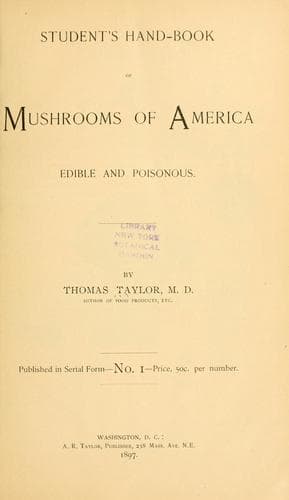
Student's Hand-book of Mushrooms of America, Edible and Poisonous — John Shaqi
Student's Hand-book of Mushrooms of America, Edible and PoisonousTaylor, Thomas
Science
Student's Hand-book of Mushrooms of America, Edible and Poisonous
Taylor, Thomas
Mushrooms -- United States; Pathogenic fungi
Of L. _piperatus_, Worthington Smith says: "So strongly acrid is the
milk that if it be allowed to trickle over tender hands it will sting
like the contact of nettles; and if a drop be placed on the lips or
tongue the sensation will be like the scalding of boiling water." He
records it as "poisonous." Fries and Curtis say that, "notwithstanding
its intense acridity, it is edible when cooked." Cordier, while
recording it as edible, says that the milk, and butter made from the
milk of cows fed with it, are bitter and nauseous, although cows eat it
with avidity. Gibson, while quoting one or two authors as to its
edibility when cooked, says: "Its decidedly ardent tang warns me not to
dwell too enthusiastically upon its merits in a limited selection of
desirable esculents." The Secretary of the Boston Mycological Club,
writing in the Club bulletin, says "it has been eaten as a sort of duty
after the acridity was cooked out," but does not commend it. It is
spoken of as "an unattractive fungus which usurps in the woods the place
that might well be occupied by something better." In this opinion I
fully concur.
L. _torminosus_, "_Wooly Lactarius_," sometimes called the "_Colic
Lactarius_," has been termed acrid and poisonous by Badham. Cordier and
Letellier, on the other hand, say that it can be eaten with impunity
when cooked. Gillet declares it deleterious and even dangerous in the
raw state, constituting a very strong and drastic purgative. One author
states that, although it does not constitute an agreeable article of
food, it is eaten in some parts of France and in Russia. Considering the
differences of opinion which exist with regard to this and other
extremely acrid species, it would seem the part of prudence for persons
with delicate stomachs to avoid the use of very acrid species, for,
though the acridity may be expelled by cooking, there would seem to be
no necessity for risking unpleasant or dangerous results while the range
of unquestionably wholesome and agreeable species is sufficiently wide
to satisfy the most enthusiastic mycophagist.
AGARICINI.
LEUCOSPORI (SPORES WHITE OR YELLOWISH).
Armillaria Fries. Cooke places Armillaria in the order Agaricini, _genus
Agaricus_, making of it a _sub_-genus. Saccardo, in taking it out of
Agaricus, elevates it to the position of a separate genus. The name
Armillaria is derived from a Greek word, meaning a ring or bracelet,
referring to its ringed stem.
In the plants of the Armillaria the veil is partial in infancy,
attaching the edge of the cap to the upper part of the stem; the stem
furnished with a ring. Below the ring the veil is concrete with the
stem, forming scurfy scales upon it. The gills are broadly adnexed. In
abnormal specimens the ring is sometimes absent, or appearing only in
scales, running down the stem. Spores white. The species are few; eight
are recorded as growing in the United States. Cooke describes twelve
species found in Great Britain.
Public-domain text, read in full here on John Shaqi.
Reviews
Reviews
No reviews yet
Be the first to share your thoughts on this work.
Join the Discussion
Join the discussion
Sign in to leave a comment or review.
Sign InorCreate an account