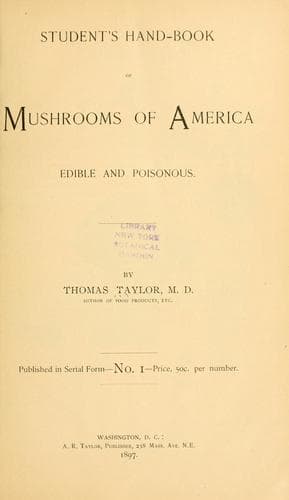
Student's Hand-book of Mushrooms of America, Edible and PoisonousTaylor, Thomas
Science
Student's Hand-book of Mushrooms of America, Edible and Poisonous
Taylor, Thomas
Mushrooms -- United States; Pathogenic fungi
The recorded edible species are found in Volvaria, Clitopilus, and
Pluteus. The Volvariae are characterized by the very large and perfect
volva which wraps the base of the stem in loose folds, the ringless
stem, and the pink, soft, liquescent gills, which are free and rounded
behind. The cap is not warted; in some species it is viscid, and in
_bombycinus_, recorded by several authors as edible, and by some as
doubtful, it is covered with a silky down.
In Clitopilus the odor of the edible species is more or less mealy. The
cap is fleshy, and the margin at first involute. Two edible species
which closely resemble each other--viz., Clitopilus _prunulus_, "Plum
mushroom," and Clitopilus _orcella_, "Sweetbread mushroom,"--are highly
recommended for their delicacy of flavor.
In Leptonia most of the species are small, thin, and brittle,
corresponding with Mycena in the white-spored series, and with Psathyra
and Psathyrella in the dark-spored series.
Eccilia corresponds with Omphalia. Claudopus corresponds with Pleurotus
in its habit of growth and lateral stem, differing in the color of the
spores.
Annularia includes only a few small species having a ringed stem, no
volva, and free pink gills. Cooke says of this subgenus that no British
species are known.
The recorded species of Pluteus have their habitat on tree stumps,
sawdust, or upon fallen timber. One species, Pluteus _cervinus_, is
recorded as edible, but not specially commended. Of Entoloma,
Worthington Smith says, "It is allied to Tricholoma, though most of the
species are thinner and often brittle. It agrees also in structure with
Hebeloma and Hypholoma." None of the species are recorded as having
value as esculents.
The genus Bolbitius is described by Cooke as a small genus intermediate
between Agaricus and Coprinus on the one side, and Coprinus and
Cortinarius on the other. The species are small and ephemeral. Saccardo
places Bolbitius in his division Melanosporae, although the spores are
ochraceous.
In the section Pratelli Psalliota and Hypholoma contain mushrooms which
are of exceptionally fine flavor. In the first of these is found the
common field mushroom Agaricus campester and its allies.
The black-spored section Coprinarii contains two genera which include a
few recorded edible species, viz., Coprinus and Gomphidius. The
Psathyrellas correspond in size to the Mycenas in the white-spored
series and to the Psathyras in the purple-spored section; the gills are
free or adnate and turn black when mature. None of the species are
edible.
In Paneolus the plants are somewhat viscid when moist, the gills are
described as "clouded, never becoming purple or brown." They are usually
found on manure heaps near cities. None are edible.
Saccardo in his Sylloge combines the Pratellae and Coprinarii, making of
them one section which he calls _Melanosporeae_.
Public-domain text, read in full here on John Shaqi.
Reviews
Reviews
No reviews yet
Be the first to share your thoughts on this work.
Elsewhere in the archive
Join the Discussion
Join the discussion
Sign in to leave a comment or review.
Sign InorCreate an account