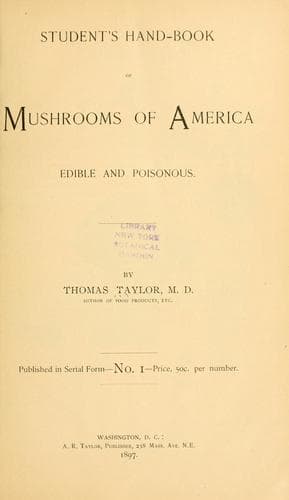
Student's Hand-book of Mushrooms of America, Edible and PoisonousTaylor, Thomas
Science
Student's Hand-book of Mushrooms of America, Edible and Poisonous
Taylor, Thomas
Mushrooms -- United States; Pathogenic fungi
According to the Brefield system, as summarized by his colleague Dr. Von
Tavel, Fungi are divided into two primary classes: (1) the
_Phycomycetes,_ or lower fungi nearest like the algae, _consisting of a
one-celled thallus with sexual as well as non-sexual modes of
reproduction_, and (2) the Mesomycetes and the Mycomycetes, _having a
divided or many celled thallus, propagated by non-sexually formed
spores_. The Phycomycetes are further divided into two large sections,
based on their methods of reproduction, termed, respectively,
Zygomycetes and Oomycetes. These include the old typical Mucors, the
Peronosporeae or "rotting moulds," once classed with the Hyphomycetes,
the Saprolegniaceae, "Fish Moulds," of aquatic habit, the
Entomophthoraceae, "Insect Moulds," together with some minor groups. The
Mesomycetes connect the Phycomycetes with the Mycomycetes. The class
Mycomycetes is primarily divided into two sections, viz., Ascomycetes
and Basidiomycetes, with the Ustilagineae, "Smut Fungi," in Mesomycetes,
forming a transitional group between Phycomycetes and the Basidiomycetal
group of the higher fungi.
The Ascomycetes are primarily subdivided into _Exoasci_ and _Carpoasci,_
groups based on the character of the asci. In the first, _Exoasci,_ the
asci are naked and borne directly on the mycelium; in the second,
_Carpoasci,_ they are enclosed in a wrapper composed of fertile hyphae
and sterile threads, having also accessory fruit forms. The first
includes Endomycetes and Taphrineae. In the second are included the
groups Gymnoasci, Perisporaceae, Pyrenomycetes, Hysteriaceae,
Discomycetes, and Helvellaceae.
The Basidiomycetes characterized by the possession of basidia are
arranged in two groups, based on the character of the basidia: (1) the
Protobasidiomycetes, in which the basidia are septate, divided, and (2)
the Autobasidiomycetes, in which the basidia are not divided, and bear a
definite number of spores.
The first of these (Protobasidiomycetes) includes the following distinct
groups: (1) the Uredineae, "Rust Fungi," which have horizontally divided
basidia, always free, never enclosed; (2) the Auricularieae, having
basidia somewhat resembling those of the Uredineae, but which are borne
in fruit bodies with open hymenia; (3) Pileacreae, having horizontal
septate basidia in closed receptacles; and (4) Tremellineae, having
vertically divided basidia borne in gymnocarpous receptacles--that is,
those in which the hymenium is exposed while the spores are growing.
The Autobasidiomycetes are characterized by undivided basidia, bearing
spores only at the apex. This group is subdivided into three sections:
(1) Dacryomycetes, which includes the lowest of the Tremelloid forms,
with club-shaped basidia, nearly approaching the true Hymenomycetal
type, together with several groups of minor import; (2) Gasteromycetes;
and (3) Hymenomycetes, with Phalloideae placed in the group as a
subsection of Gasteromycetes.
Public-domain text, read in full here on John Shaqi.
Reviews
Reviews
No reviews yet
Be the first to share your thoughts on this work.
Elsewhere in the archive
Join the Discussion
Join the discussion
Sign in to leave a comment or review.
Sign InorCreate an account