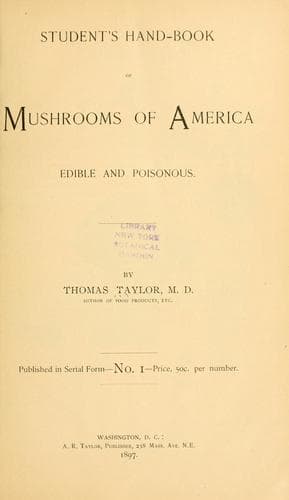
Student's Hand-book of Mushrooms of America, Edible and PoisonousTaylor, Thomas
Science
Student's Hand-book of Mushrooms of America, Edible and Poisonous
Taylor, Thomas
Mushrooms -- United States; Pathogenic fungi
The above can only be considered as a very brief abstract of the system
of classification proposed by Dr. Brefield, but it will serve to give
some idea of the principle on which the system is based, which is
sufficient for our present purpose. Those who wish to study the system
in detail will find it treated in a comprehensive manner in Dr. Von
Tavel's summary as it appears in the _Vergleichende Morphologie der
Pilze_, Jena, 1892.
CONIOMYCETES AND HYPHOMYCETES.
In the original classification of Fries two of the primary divisions of
the sporiferous Fungi were termed, respectively, _Coniomycetes_ and
_Hyphomycetes_. This arrangement was accepted by Berkeley, the term
_Coniomycetes_ being applied to all fungi in which the naked spores,
appearing like an impalpable dust, were the principal feature of the
plant, and the term _Hyphomycetes_ to fungi in which the threads or
hyphae bearing the spores were the most conspicuous feature.
Coniomycetes, as broadly interpreted by Berkeley and other mycologists
of his day, included the Uredineae or "rust fungi," the Ustilagines or
"smut fungi," the Sphaeropsideae, and the Melanconieae. This arrangement
was very unsatisfactory on account of the distinctively different
character of the methods of reproduction of the respective groups, and
they have since been disassociated and by some authors ranked as
distinct orders or families. Others combine Uredinei and Ustilaginei in
one group under the name Hypodermei.
Familiar examples of Uredinei are seen in the rust of the Barberry leaf,
etc., and of the Ustilaginei in the "smut" of corn and the "bunt" of
wheat.
Some authors combine the Sphaeropsideae with the closely allied
Melanconieae. M. C. Cooke contends that the _Sphaeropsideae_ should be
considered apart from the _Melanconieae,_ on the fundamental basis that
the former possess a distinct perithecium, while the latter do not.
The _Sphaeropsideae_ as recently defined by Cooke are "Fungi _possessed of
a perithecium, but without asci_, ... sporules or stylospores being
produced internally at the apex of more or less distinct supporting
hyphae or pedicels, termed sporophores."
The Sphaeropsideae somewhat resemble the Pyrenomyceteae in external
characteristics, but differ from them in the absence of asci and
paraphyses. Saccardo retains all the species in his Sylloge, but
relegates them to an inferior position as imperfect fungi.
The group _Pyrenomycetes_, or _Sphaeriacei_, as at first recognized by
_Fries_, included not only the _Sphaeriacei_ and the _Perisporacei_, but
also the _Sphaeropsidei_ and _Melanconiaceae_. Later, when ascigerous
fungi were separated from stylosporous fungi, this group was revised,
the ascigerous species only being retained. As at present limited, the
Pyrenomycetes are "_ascigerous_ fungi having the fructification enclosed
within a perithecium."
Public-domain text, read in full here on John Shaqi.
Reviews
Reviews
No reviews yet
Be the first to share your thoughts on this work.
Elsewhere in the archive
Join the Discussion
Join the discussion
Sign in to leave a comment or review.
Sign InorCreate an account