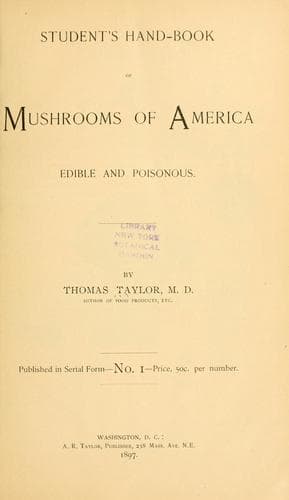
Student's Hand-book of Mushrooms of America, Edible and PoisonousTaylor, Thomas
Science
Student's Hand-book of Mushrooms of America, Edible and Poisonous
Taylor, Thomas
Mushrooms -- United States; Pathogenic fungi
Plant dingy white or brownish yellow; pear-shaped, or obovate pyriforme,
sometimes approaching L. gemmatum in size and shape, but easily
distinguished from that species by the surface features of the peridium
and the internal hyphae. The persistent warts which cover the surface of
the peridium are so minute as to appear to the naked eye like scales. In
some instances the peridium is almost smooth, and sometimes cracks in
areas, inner peridium thin and tough. The hyphae are thicker than the
spores and branched, continuous with the slightly cellular base, and
forming a columella inside the peridium. Spores greenish-yellow, then
brownish-olive, smooth and globose.
The short stem-like base of the plant terminates in fiber-like rootlets,
creeping under the soil and branching, thus attaching large clusters of
the young plants together. They are often found in quantity on the mossy
trunks of fallen trees.
FIG. 6.--=Lycoperdon giganteum= Batsch. "_Giant Puff-Ball_."
The Giant Puff-Ball, so generally neglected, is one of the most valuable
of the edible mushrooms. It is readily distinguished from other
puff-balls and allied fungi by its large size. It is subglobose in form,
often flattened at the top and usually wider than deep. The peridium or
rind is membranaceous, smooth, or very slightly floccose, and creamy
white at first, turning to pale yellowish-brown when the plant is old.
When young it is filled with a white, seemingly homogeneous fleshy
substance of pleasant flavor. This substance changes, when mature, to an
elastic, yellowish or olivaceous brown, cottony but dusty mass of
filaments and spores. The peridium is very fragile above, cracking into
areae in the mature plant and breaking up and falling away in fragments,
thus allowing the dispersion of the spores. The capillitium and spores
are at first greenish-yellow, turning to dingy olive. The plants vary in
size, but average from ten to twenty inches in diameter. In the columns
of the _Country Gentleman_ some years ago there appeared a description
of a puff-ball of this species which weighed forty seven pounds and
measured a little over eight feet in circumference. It was found in a
low, moist corner of a public park. Specimens weighing from twenty to
thirty pounds are recorded as being found in different parts of the
country; but specimens of such large dimensions are unusual. This
species is found in many parts of the United States. It is the L.
_bovista_ of Linn. Sacc.
A correspondent writes that he has found the giant puff-ball in great
abundance growing on the Genessee Flats, Livingstone Co., New York.
Another writes from Nebraska that it is quite abundant on the prairies
there in summer. A third writes from Missouri, "Since the late rains we
have had puff-balls in abundance, and find them delicious made into
fritters."
Public-domain text, read in full here on John Shaqi.
Reviews
Reviews
No reviews yet
Be the first to share your thoughts on this work.
Elsewhere in the archive
Join the Discussion
Join the discussion
Sign in to leave a comment or review.
Sign InorCreate an account