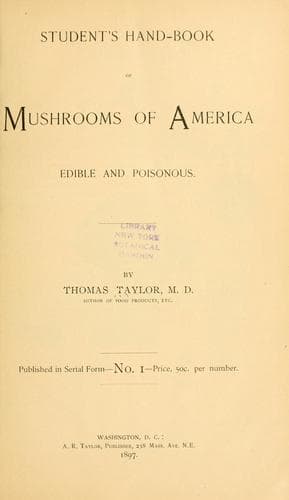
Student's Hand-book of Mushrooms of America, Edible and PoisonousTaylor, Thomas
Science
Student's Hand-book of Mushrooms of America, Edible and Poisonous
Taylor, Thomas
Mushrooms -- United States; Pathogenic fungi
The puff-balls should be gathered young. If the substance within is
white and pulpy, it is in good condition for cooking, but if marked with
yellow stains it should be rejected.
Vittadini says:
"When the giant puff-ball is conveniently situated you should only take
one slice at a time, cutting it horizontally and using great care not to
disturb its growth, to prevent decay, and thus one may have a fritter
every day for a week."
Different authors write with enthusiasm of the merits of the giant
puff-ball as an esculent.
Mrs. Hussey, an English botanist, gives the following receipt for
"puff-ball omelet:"
First, remove the outer skin; cut in slices half an inch thick; have
ready some chopped herbs, pepper, and salt; dip the slices in the yolk
of an egg, and sprinkle the herbs upon them; fry in fresh butter, and
eat immediately.
I have tested fine specimens of the giant puff-ball gathered in the
public parks of Washington, D. C., finding it delicious eating when
fried in batter.
FIGS. 7 and 8.--=Lycoperdon cyathiforme= Bose. "_Cup-shaped
Puff-Ball_."
Synonyms--L. fragile Vitt. L. albopurpureum Frost.
Plant nearly globose, with a short, thick, stem-like base, color
varying, cinereous, brown, tinged with violet.
Rind or peridium smooth, or minutely floccose, scaly in the mature
plant, cracking into somewhat angular areas, the upper portion finally
falling away in fragments, leaving a wide cup-shaped base, with
irregular margin, which remains long after the dispersion of the spores
and capillitium. This basal portion is often tinged with the purplish
hue of the spores. Spores rough, purplish-brown. Capillitium same color
as the spores.
Lycoperdon _cyathiforme_ is a more common species than L. _giganteum_,
and is deemed quite equal to the latter in flavor. The plants are of
good size, being from 4 to 10 inches in diameter.
They are frequently found in open fields and grassy places after
electric storms. When sliced and fried in egg batter, they taste much
like the _giganteum_ or _giant puff-ball_.
A puff-ball which is not inferior to either of the two last-named
species, though not as large, and perhaps not as abundant as either, is
the Lycoperdon _saccatum_ of Fries, sometimes called the "Long-stemmed
puff-ball," because of its elongated stem.
The plants of this species are attractive in appearance, usually
hemispherical, or lentiform in shape, with cylindrical stem-like base.
The peridium is thin and delicate, breaking into fragments; creamy white
in the young stage, and clothed with delicate warts, so minute as to
give the surface a soft mealy appearance, the under surface somewhat
plicate. Capillitium sub-persistent and dense. Both spores and
capillitium brown.
LYCOPERDACEAE.
Public-domain text, read in full here on John Shaqi.
Reviews
Reviews
No reviews yet
Be the first to share your thoughts on this work.
Elsewhere in the archive
Join the Discussion
Join the discussion
Sign in to leave a comment or review.
Sign InorCreate an account