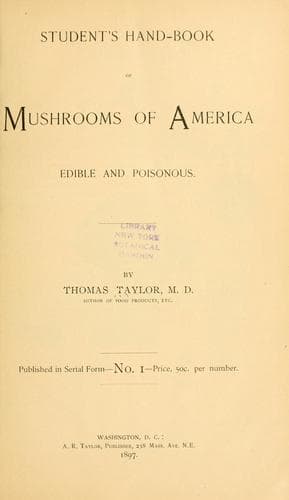
Student's Hand-book of Mushrooms of America, Edible and PoisonousTaylor, Thomas
Science
Student's Hand-book of Mushrooms of America, Edible and Poisonous
Taylor, Thomas
Mushrooms -- United States; Pathogenic fungi
In their early history the Myxomycetes, or "slime moulds," were classed
with the gasteromycetal fungi, and by Fries grouped as a sub-order of
the Gasteromycetes, under the name Myxogasters. From this connection
they were severed in 1833 by Link, who, recognizing certain distinctive
features which entitled them to consideration as an entirely separate
group, ranked the Myxogasters, as a separate order, under the title
_Myxomycetes_, _Slime moulds_. De Bary, in a monograph on the subject
written some years later, questioned the right of this group to the
place assigned it in the vegetable world, claiming that the Myxogasters
were as nearly related to the animal as to the vegetable kingdom, and
changing the name to Mycetozoa. Massee assailed this position in his
"Monograph of the Myxogasters," pointing out that De Bary derived his
reasons and deductions from the early or vegetative stage of the fungi,
without taking sufficiently into account the characteristics of the
later or reproductive stage in which the great disparity between these
organisms and those of the lower animals becomes apparent.
Dr. Rostafinski, the Polish botanist, and pupil of De Bary, adopts the
name given the group by De Bary, but applies it in a more restricted
sense, classifying on a botanical basis. Both De Bary and Massee have
their earnest disciples. M. C. Cooke takes the ground that the
Myxomycetes are entitled to mention as "_fungi_ which produce their
fructification enclosed within a peridium," although considering them as
an aberrant group which, on account of certain peculiarities of their
early or vegetative stage, should no longer be classed as having
affinity with Gasteromycetes. Without further discussion of the subject,
it is sufficient, for our present purpose, to state that mycologists now
very generally agree in regarding this group as quite distinct from the
Gasteromycetes.
The species are minute, rarely exceeding a millimeter in diameter, at
first pulpy, then dry. In the early or vegetative stage the "slime
mould" is plasmoidal, consisting of a mass of protoplasm without cell
wall, and prefers damp surfaces, such as rotting leaves, moist logs,
etc. The whole substance is slippery or slimy and presents different
hues, red, orange, violet, brown, etc., according to species, but never
green. It is in the reproductive or fruiting stage that their
resemblance to microscopic puff-balls appears, the sporangium in many
species exhibiting a distinct peridium or outer coat which encloses the
spores together with the hair-like threads called the capillitium. On
the ripening of the spores this peridium ruptures, allowing their
escape, the capillitium lending valuable aid in their dissemination.
GENERA OF GASTEROMYCETES, ACCORDING TO SACCARDO.
I.--PHALLACEAE, OR PHALLOIDEAE.
Public-domain text, read in full here on John Shaqi.
Reviews
Reviews
No reviews yet
Be the first to share your thoughts on this work.
Elsewhere in the archive
Join the Discussion
Join the discussion
Sign in to leave a comment or review.
Sign InorCreate an account