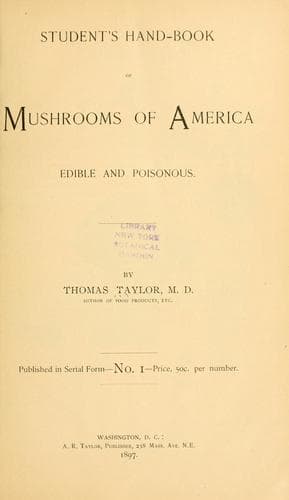
Student's Hand-book of Mushrooms of America, Edible and PoisonousTaylor, Thomas
Science
Student's Hand-book of Mushrooms of America, Edible and Poisonous
Taylor, Thomas
Mushrooms -- United States; Pathogenic fungi
The genus Cortinarius is a large one, and contains many beautiful
species. It is mainly confined to temperate regions. Not a single
species has been recorded as found in Ceylon, the West Indies, or
Africa, but one tropical species is found in Brazil. Nearly four hundred
species have been described, and over three hundred and seventy of these
belong to the United States and Europe. A few are found in the extreme
southern or temperate portion of South America, and several are reported
from a temperate elevation among the Himalayas. Sweden and Great
Britain, with their temperate climates, claim a large proportion of the
European species. Not many of the Cortinarii have been recorded as
edible, and none as dangerous. The Rev. M. J. Berkeley records, however,
a case of poisoning by one of the species, C. (Inoloma) _bolaris_ Pers.,
which though not fatal was somewhat alarming, the symptoms being great
oppression of the chest, profuse perspiration, and the enlargement for
two days of the salivary glands of the patient. I have seen no other
statements relating to the poisonous properties of this species, and the
results alluded to may have been owing to some individual idiosyncrasy.
Berkeley, in his "Outlines," gives the following description of this
mushroom: "Pileus fleshy, obsoletely umbonate, growing pale, variegated
with _saffron-red, adpressed, innate_ scales; stem stuffed, then hollow,
nearly equal, squamose, of the same color as the cap; gills
subdecurrent, crowded, watery, cinnamon color. Cap 1 to 2 inches broad.
Stem 2 to 3 inches long." In beech woods in September and October.
The genus Cortinarius has been divided by some authors into the
following six groups: (1) _Phlegmacium_, in which the cap is fleshy and
viscid, the veil partial, and the stem firm and dry; (2) _Myxacium_, in
which the veil is universal and glutinous, hence the cap and stem both
viscid; cap thin and the gills adnate or decurrent; (3) _Inoloma_, in
which the cap is fleshy, dry, and at first silky with innate fibrils;
veil simple and stem slightly bulbous; (4) Dermocybe, in which the
pileus is thinly fleshy, dry, and at first downy, becoming smooth; the
veil single and fibrillose; flesh watery, colored when moist, stem equal
or attenuated downwards; (5) Telamonia, in which the cap is moist, at
first smooth or dotted with the superficial fragments of the veil, the
stem ringed below, or peronately scaly from the remains of the universal
veil; (6) Hydrocybe, in which the cap is thin and moist, not viscid,
smooth, or covered with superficial white fibrils; stem rigid, not
scaly, veil thin, occasionally collapsed in an irregular ring. These
subdivisions have been designated as _tribes_ by some botanists and
_subgenera_ by others, etc. To the divisions Inoloma and Phlegmacium,
respectively, belong the two species illustrated in Plate XII.
Public-domain text, read in full here on John Shaqi.
Reviews
Reviews
No reviews yet
Be the first to share your thoughts on this work.
Elsewhere in the archive
Join the Discussion
Join the discussion
Sign in to leave a comment or review.
Sign InorCreate an account