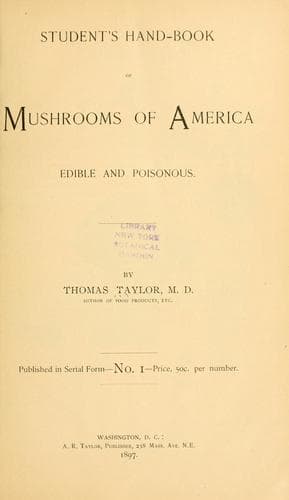
Student's Hand-book of Mushrooms of America, Edible and PoisonousTaylor, Thomas
Science
Student's Hand-book of Mushrooms of America, Edible and Poisonous
Taylor, Thomas
Mushrooms -- United States; Pathogenic fungi
Lepiota _Morgani_ Peck, the "_Green-Spored Lepiota_," is an exception to
the general type of Lepiotas in the color of its gills and spores. It is
western and southern in its range. This species is described by Peck in
the Botanical Gazette of March, 1897, p. 137, as follows: "Pileus
fleshy, soft, at first sub-globose, then expanded, or depressed, white,
the brownish or alutaceous cuticle breaking up into scales except on the
disk; lamellae close, lanceolate, remote, white, then green; stem firm,
equal, or tapering upwards, sub-bulbous, smooth, webby-stuffed, whitish,
tinged with brown, annulus rather large, movable; flesh both of the
pileus and stem white, changing to reddish, and then to yellowish hue
when cut or bruised; spores ovate, sub-elliptical, mostly uninucleate,
.0004 to .0005 inches long, .0003 to .00032 broad, sordid green.
"Plant 6 to 8 inches high, pileus 5 to 9 inches broad, stem 6 to 12
lines thick. Open dry grassy places. Dayton, Ohio. A. P. Morgan."
AGARICINI.
_Genus Cortinarius_ Fries. This genus is distinguished by a cob-web-like
veil, dry persistent gills, which in the mature plants become
discolored, and pulverulent with the rusty or ochraceous colored spores.
The veil is very delicate, resembling a spider's web. It is not concrete
with the cuticle of the cap, but extends from its margin to the stem, in
the young plants sometimes concealing the gills, but disappearing as the
cap expands. Sometimes a few filaments are seen depending from the
margin of the cap or encircling the stem.
In the young plants of this genus the gills vary very much in color.
They are whitish, clay-color, violet, dark purple, blood-red, etc.,
according to species, but, as the plants mature, the gills become dusted
with the rust-colored falling spores, and with age usually become a
rusty ochraceous, or cinnamon color. The stem in some of the species is
distinctly bulbous and in others equal, cylindrical, or tapering. In
identifying the species it is necessary, in order to ascertain the true
color of the gills, to examine the plants at different periods of
growth.
Public-domain text, read in full here on John Shaqi.
Reviews
Reviews
No reviews yet
Be the first to share your thoughts on this work.
Elsewhere in the archive
Join the Discussion
Join the discussion
Sign in to leave a comment or review.
Sign InorCreate an account