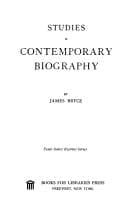
Studies in Contemporary BiographyBryce, James Bryce, Viscount
History
Studies in Contemporary Biography
Bryce, James Bryce, Viscount
Great Britain -- Biography
When Lord Acton died on 19th June 1902, at Tegern See in Bavaria,
England lost the most truly cosmopolitan of her children, and Europe
lost one who was, by universal consent, in the foremost rank of her
men of learning. He belonged to an old Roman Catholic family of
Shropshire, a branch of which had gone to Southern Italy, where his
grandfather, General Acton, had been chief minister of the King of
Naples in the great war, at the time when the Bourbon dynasty
maintained itself in Sicily by the help of the British fleet, while
all Italy lay under the heel of Napoleon. His father, Sir Ferdinand
Acton, married a German lady, heiress of the ancient and famous house
of Dalberg, one of the great families of the middle Rhineland; so John
Edward Emerich Dalberg-Acton was born half a German, and connected by
blood with the highest aristocracy of Germany. He was educated at
Oscott, one of the two chief Roman Catholic colleges of England, under
Dr. Wiseman, afterwards Archbishop of Westminster and Cardinal; but
the most powerful influence on the development of his mind and
principles came from that glory of Catholic learning, a beautiful soul
as well as a capacious intellect, Dr. von Doellinger, with whom Acton
studied during some years at Munich. He sat for a short time in the
House of Commons as member for Carlow (1859); and was afterwards
elected for Bridgnorth (1865), but lost his seat (which he had gained
by one vote only) on a scrutiny. In those days it was not easy for a
Roman Catholic to find an English constituency, so in 1869 Mr.
Gladstone procured his elevation to the peerage. He made a successful
speech in the House of Lords in 1893, but took no prominent part in
parliamentary life in either House, feeling himself too much of a
student, and looking at current questions from a point of view unlike
that of English politicians. Neither as a philosopher, nor as a
historian, nor as a product of German training, could he find either
Lords or Commons a congenial audience. When he was asked soon after he
entered Parliament why he did not speak, he answered that he agreed
with nobody and nobody agreed with him. But since he regarded politics
as history in the course of making under his eyes, he continued to be
all his life keenly interested in public affairs, watching and judging
every move in the game. Mr. Gladstone, whose trusted friend he had
been for many years, was believed to have on one occasion wished to
place him in an important office; but political exigencies made this
impossible, and the only public post he ever held was that of
Lord-in-Waiting in the Ministry of 1892. In this capacity he was
brought into frequent contact with Queen Victoria, who felt the
warmest respect and admiration for him. He was one of the very few
persons surrounding her who was familiar with most of the courts of
Continental Europe, and could discuss with her from direct knowledge
the men who figured in those courts. At Windsor he spent in the
Public-domain text, read in full here on John Shaqi.
Reviews
Reviews
No reviews yet
Be the first to share your thoughts on this work.
Elsewhere in the archive
Join the Discussion
Join the discussion
Sign in to leave a comment or review.
Sign InorCreate an account