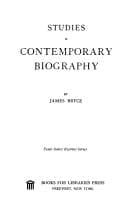
Studies in Contemporary BiographyBryce, James Bryce, Viscount
History
Studies in Contemporary Biography
Bryce, James Bryce, Viscount
Great Britain -- Biography
library of the Castle all the time during which he was not required to
be in actual attendance on the Queen, a singular phenomenon among
Lords-in-Waiting.
Unlike most English Roman Catholics, he was a strong Liberal, a
Liberal of that orthodox type, individualist, free-trade, and
peace-loving, which prevailed from 1846 till 1885. He was also a
convinced Home Ruler, and had, indeed, adopted the principle of Home
Rule for Ireland long before Mr. Gladstone himself was converted to
it. His faith in that principle rested on the value he attached to
self-government as a means of training and developing the political
aptitudes of a people, and to the recognition of national sentiment,
which he held to be, like other natural forces, useful when guided but
formidable when repressed. So too his Liberalism was based on the love
of freedom for its own sake, joined to the conviction that freedom is
the best foundation for the stability of a constitution and the
happiness of a people. Reliance on the power of freedom was, he used
to say, one of the broadest of all the lessons he had learned from
history. He applied it in ecclesiastical as well as in political
affairs. At the time of the Vatican Council of 1870 he was, though a
layman, prominent among those who constituted the opposition
maintained by the Liberal section of the Roman Catholic Church to the
affirmation of the dogma of papal infallibility. His full and accurate
knowledge of ecclesiastical history was placed at the disposal of the
prelates, such as Archbishop Dupanloup, Bishop Strossmayer, and
Archbishop Conolly (of Halifax, Nova Scotia), who combated the
Ultramontane party in the animated and protracted debates which
illumined that OEcumenical Council. One, at least, of the treatises,
and many of the letters in the press which the Council called forth
were written either by him or from materials which he supplied, and he
was recognised by the Ultramontanes, and in particular by Archbishop
Manning, as being, along with Doellinger, the most formidable of their
opponents behind the scenes. As every one knows, the Infallibilists
triumphed, and the schism which led to the formation of the Old
Catholic Church in Germany and Switzerland was the result. Doellinger
was excommunicated; but against Lord Acton no action was taken, and he
remained all his life a faithful member of the Roman communion, while
adhering to the views he had advocated in 1870.
Public-domain text, read in full here on John Shaqi.
Reviews
Reviews
No reviews yet
Be the first to share your thoughts on this work.
Elsewhere in the archive
Join the Discussion
Join the discussion
Sign in to leave a comment or review.
Sign InorCreate an account