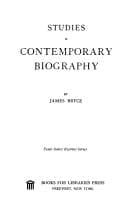
Studies in Contemporary BiographyBryce, James Bryce, Viscount
History
Studies in Contemporary Biography
Bryce, James Bryce, Viscount
Great Britain -- Biography
Mr. Gladstone had the defects ascribed to him. His impulsiveness
sometimes betrayed him into declarations which a cooler reflection
would have dissuaded. The second reading of the Irish Home Rule Bill
of 1886 might possibly have been carried had he not been goaded by his
opponents into words which were construed as recalling or modifying
the concessions he had announced at a meeting of the Liberal party
held just before. More than once precious time was wasted because
antagonists, knowing his excitable temper, brought on discussions with
the sole object of annoying him and drawing from him some hasty
deliverance. Nor was he an adept, like Disraeli and Disraeli's famous
Canadian imitator, Sir John A. Macdonald, in the management of
individuals. His aversion for the meaner side of human nature made him
refuse to play upon it. Many of the pursuits, and most of the
pleasures, which attract ordinary men had no interest for him, so that
much of the common ground on which men meet was closed to him. He was,
moreover, too constantly engrossed by the subjects he loved, and by
enterprises which specially appealed to him, to have leisure for the
lighter but often vitally important devices of political strategy. I
remember hearing, soon after 1870, how Mr. Delane, then editor of the
_Times_, had been invited to meet the Prime Minister at a moment when
the support of that newspaper would have been specially valuable to
the Liberal Government. Instead of using the opportunity in the way
that had been intended, Mr. Gladstone dilated during the whole time of
dinner upon the approaching exhaustion of the English coal-beds, to
the surprise of the company and the unconcealed annoyance of the
powerful guest. It was the subject then uppermost in his mind, and he
either forgot, or disdained, to conciliate Mr. Delane. Good nature as
well as good sense made him avoid giving offence by personal
reflections in debate, and he usually suffered fools if not, like St.
Paul's converts, gladly, yet patiently.[64] In the House of Commons he
was entirely free from airs, and, indeed, from any assumption of
superiority. The youngest member might accost him in the lobby and be
listened to with perfect courtesy. But he had a bad memory for faces,
seldom addressed any one outside the circle of his personal friends,
and more than once made enemies by omitting to notice and show
attention to recruits who, having been eminent in their own towns,
expected to be made much of when they entered Parliament. Having
himself plenty of pride and comparatively little vanity, he never
realised the extent to which, and the cheapness with which, men can be
captured and used through their vanity. Adherents were sometimes
turned into dangerous foes because his preoccupation with graver
matters dimmed his sense of what may be done to win support by the
minor arts, such as an invitation to dinner or even a seasonable
compliment. And his mind, flexible as it was in seizing new points of
Public-domain text, read in full here on John Shaqi.
Reviews
Reviews
No reviews yet
Be the first to share your thoughts on this work.
Elsewhere in the archive
Join the Discussion
Join the discussion
Sign in to leave a comment or review.
Sign InorCreate an account