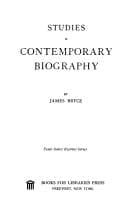
Studies in Contemporary BiographyBryce, James Bryce, Viscount
History
Studies in Contemporary Biography
Bryce, James Bryce, Viscount
Great Britain -- Biography
After the death of Thomas Carlyle he was probably the best talker in
London, and a talker in one respect more agreeable than either Carlyle
or Macaulay, inasmuch as he was no less ready to listen than to speak,
and never wearied the dinner-table by a monologue. His simplicity, his
spontaneity, his geniality and courtesy, as well as the fund of
knowledge and of personal recollections at his command, made him so
popular in society that his opponents used to say it was dangerous to
meet him, because one might be forced to leave off hating him. He was,
perhaps, too prone to go on talking upon the subject which filled his
mind at the moment; nor was it easy to divert his attention to
something else which others might deem more important.[74] Those who
stayed with him in the same country house sometimes complained that
the perpetual display of force and eagerness tired them, as one tires
of watching the rush of Niagara. His guests, however, did not feel
this, for his own home life was quiet and smooth. He read and wrote a
good many hours daily, but never sat up late, almost always slept
soundly, never seemed oppressed or driven to strain his strength. With
all his impetuosity, he was regular, systematic, and deliberate in his
habits and ways of doing business. A swift reader and a surprisingly
swift writer, he was always occupied, and was skilful in using even
the scraps and fragments of his time. No pressure of work made him
fussy, nor could any one remember to have seen him in a hurry.
The best proof of his swiftness, industry, and skill in economising
time is supplied by the quantity of his literary work, which,
considering the abstruse nature of the subjects to which much of it is
related, would have been creditable to the diligence of a German
professor sitting alone in his study. The merits of the work have been
disputed. Mankind are slow to credit the same person with eminence in
various fields. When they read the prose of a great poet, they try it
by severer tests than would be applied to other writers. When a
painter has won credit by his landscapes or his cattle pieces, he is
seldom encouraged to venture into other lines. So Mr. Gladstone's
reputation as an orator stood in his own light when he appeared as an
author. He was read by thousands who would not have looked at the
article or book had it borne some other name; but he was judged by the
standard, not of his finest printed speeches, for his speeches were
seldom models of composition, but rather by the impression which his
finest speeches made on those who heard them. Since his warmest
admirers could not claim for him as a writer of prose any such
pre-eminence as belonged to him as a speaker, it followed that his
written work was not duly appreciated. Had he been a writer and
nothing else, he would have been eminent and powerful by his pen.
Public-domain text, read in full here on John Shaqi.
Reviews
Reviews
No reviews yet
Be the first to share your thoughts on this work.
Elsewhere in the archive
Join the Discussion
Join the discussion
Sign in to leave a comment or review.
Sign InorCreate an account