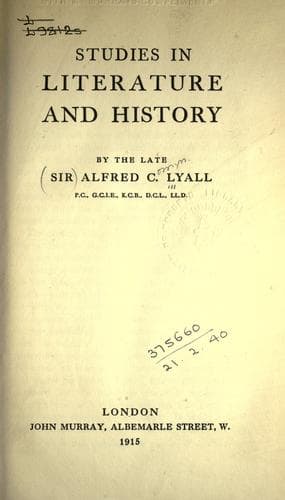
Studies in Literature and HistoryLyall, Alfred C., Sir
Religion
Studies in Literature and History
Lyall, Alfred C., Sir
English literature; History; Literature; Religion; Utilitarianism
On reaching home Captain West learns, like the elder Wetherby in
Lang's story, that an uncle has died leaving him a good income; so he
enters Parliament, and the remainder of his autobiography is entirely
occupied by an account of his efforts in the cause of army reform,
which eventually succeed when he has overcome the scruples and
hesitation of the prime minister--Mr. Merriman, a transparent
pseudonym. The author's plan of endeavouring to interest his readers
in professional and technical questions is very creditably carried
out, for the book is throughout readable; and it also shows that on
the subject of military organisation Chesney was often in advance of
his time; but the scene changes from India to England so very early in
the narrative that this novel takes a place on our list more by reason
of its Anglo-Indian authorship than of its connection with India.
In _The Dilemma_, on the other hand, Chesney gives us a story with
characters and catastrophes drawn entirely from the sepoy mutiny. The
main interest centres round the defence of a house in some up-country
station that is besieged by the mutineers, and for such a purpose the
writer could supply himself, at discretion, from the abundant
repertory of adventures and the variety of personal conduct--heroic,
humorous, or otherwise astonishing--which had been provided by actual
and recent events. We have here, indeed, a dramatic version of real
history; and, since the original of an intensely tragic situation must
always transcend a literary adaptation of it, the fiction necessarily
suffers by comparison with the fact. Yet the novel contends not
unsuccessfully with this disadvantage, and in the lapse of years, as
the real scenes and piercing emotions stirred up by a bloody struggle
fade into distance, the value of Chesney's work may increase. For it
preserves a true picture, drawn at first hand, of the time, the
circumstances, and the behaviour of an isolated group of English folk
who, while living in a state of profound peace and apparent security,
found themselves suddenly obliged to fight desperately for their lives
against an enemy from whom no quarter, even for women and children,
could be expected in case of defeat.
Public-domain text, read in full here on John Shaqi.
Reviews
Reviews
No reviews yet
Be the first to share your thoughts on this work.
Elsewhere in the archive
Join the Discussion
Join the discussion
Sign in to leave a comment or review.
Sign InorCreate an account