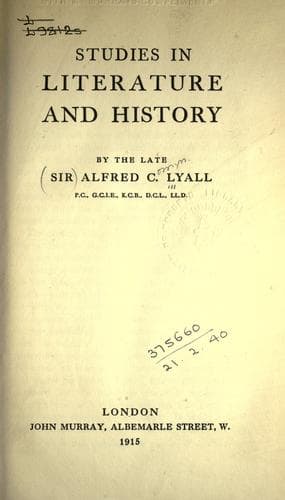
Studies in Literature and HistoryLyall, Alfred C., Sir
Religion
Studies in Literature and History
Lyall, Alfred C., Sir
English literature; History; Literature; Religion; Utilitarianism
When we turn to the Indian novels written after the Mutiny we are in
the clearer and lighter atmosphere of the contemporary social novel.
We have left behind the theoretic enthusiast, perplexed by the
contrast between the semi-barbarism of the country and the
old-fashioned apathy of its rulers; we have no more descriptions,
serious or sarcastic, of rakish subalterns and disorderly regiments
under ancient, incapable colonels; we are introduced to a reformed
Anglo-India, full of hard-working, efficient officers, civil and
military, and sufficiently decorous, except where hill-stations foster
flirting and the ordinary dissipation of any garrison town. It is,
however, still a characteristic of the post-Mutiny stories that they
find very little room for natives; the secret of successfully
interpreting Indian life and ideas to the English public in this form
still awaits discovery. One of the best and most popular of the new
school was the late Sir George Chesney, whose _Battle of Dorking_ was
a stroke of genius, and who utilised his Indian experiences with very
considerable literary skill, weaving his projects of army reform into
a lively tale of everyday society abroad and at home. The scene of _A
True Reformer_ opens at Simla, under Lord Mayo's vice-royalty, names
and places being very thinly disguised; the hero marries a pretty
girl, and starts homeward on furlough, thereby giving the writer his
opportunity for bringing in a description of a railway journey across
India to Bombay in the scorching heat of May:
'And now the day goes wearily on, marked only by the change of the
sun's shadow, the rising of the day-wind and its accompaniment of
dust, and the ever-increasing heat. The country is everywhere the
same--a perfectly flat, desert-looking plain of reddish brown hue,
with here and there a village, its walls of the same colour. It
looks a desert, because there are no signs of crops, which were
reaped two months ago, and no hedgerows, but here and there an
acacia tree. Not a traveller is stirring on the road, not a soul to
be seen in the fields, but an occasional stunted bullock is
standing in such shade as their trees afford. At about every ten
miles a station is reached, each exactly like the previous one and
the next following.... Gradually the sun went down, the wind and
dust subsided, and another stifling night succeeded, with uneasy
slumbers, broken by the ever-recurring hubbub of the stoppages.'
Public-domain text, read in full here on John Shaqi.
Reviews
Reviews
No reviews yet
Be the first to share your thoughts on this work.
Elsewhere in the archive
Join the Discussion
Join the discussion
Sign in to leave a comment or review.
Sign InorCreate an account