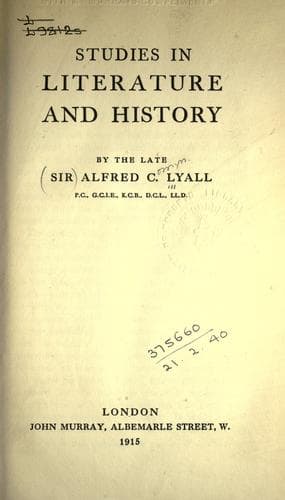
Studies in Literature and HistoryLyall, Alfred C., Sir
Religion
Studies in Literature and History
Lyall, Alfred C., Sir
English literature; History; Literature; Religion; Utilitarianism
his property but his life, according to an ancient and authentic
custom among Rajput folk, as formerly throughout India, whereby a man
who has no other means of enforcing a just claim against a powerful
debtor has always the resource of bringing down upon him a fearful
curse by committing suicide before his door. The Rajput chief pretends
that the bond is illegal and void, being founded upon an obsolete
custom disallowed by the English rulers; but in truth he has brought
himself to believe that the blood penalty will not really be paid, and
he is struck with horror when the Bhat, after formal and public
warning, stabs his own mother in the chief's presence, whereupon the
curse falls and clings to the family. We may add that the substitution
of the Bhat's mother for himself as an expiatory victim is in
accordance with accepted precedents on such occasions, while it makes
room for a pathetic situation, and greatly enhances the dramatic
interest of the closing scene. Here we have the antique Oriental
version of the story in Shakespeare's _Merchant of Venice_, where
Shylock takes the same kind of security from Antonio, upon whose
person he subsequently demands execution of his bond of blood; nor
does the law refuse it to him. But the Hindu custom is so far milder
than the Venetian code that the Rajput Shylock could not have rejected
a tender of full payment in cash. Mr. Forrest's tale might be turned
into an effective stage-tragedy if the main incident were not too
shockingly improbable for Europeans, although to an Indian audience it
would be credible enough. The final scene of the mother's death is
stamped on the reader's imagination by the writer's power of giving
intense significance not only to the speech but to slight movements of
the actors, so that the mental picture becomes almost objective, while
the strained expectation of the crowd makes itself felt by the force
of the words.
'"Will you redeem the bond?" asks the herald once more.
'"Say 'No,'" exclaims Takht Singh.
'"No," shouts Hurdeo Singh (the chief).
'"Then blood must be shed at your door, and the life forfeit paid
at your threshold, so that the curse may alight upon you and your
house."
'He draws the dagger from its sheath. He had not laid his hand
upon its handle in the same manner that he would have laid it on
the hilt of his sword, but the reverse way to that; he puts the
palm of his hand under it and not over it, so he could best use it
in the way he intended to use it--so could he best strike the blow
he meant to strike.
'"Begone! Begone!" shouts Hurdeo Singh, waving him away with his
hand.
'The people around stand fixed as statues, eyes straining, necks
craning. The herald stretches his left arm behind his mother, and
she, throwing open her _chudder_, leans back against it....
'The money-lender had given a sudden cry, stretched out his hand,
uttered some words.
Public-domain text, read in full here on John Shaqi.
Reviews
Reviews
No reviews yet
Be the first to share your thoughts on this work.
Elsewhere in the archive
Join the Discussion
Join the discussion
Sign in to leave a comment or review.
Sign InorCreate an account