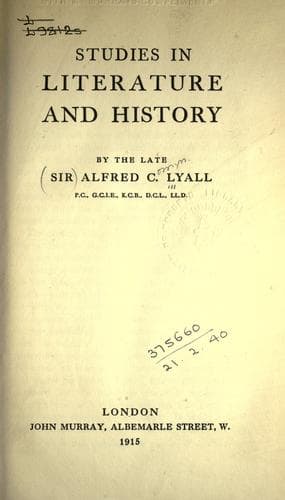
Studies in Literature and HistoryLyall, Alfred C., Sir
Religion
Studies in Literature and History
Lyall, Alfred C., Sir
English literature; History; Literature; Religion; Utilitarianism
'When Hurdeo Singh had beheld the herald raise his right arm, his
own had gone up with it, and from his mouth had come the cry,
"Don't! Don't."
'But it was too late. The herald had raised his arm, turned round
his head, and plunged the sharp stiletto into his mother's breast.'
It would be scarcely possible in an article that ranges over the light
literature of Anglo-India to omit mentioning the name of Mr. Rudyard
Kipling, who is the most prominent and by far the most popular of
Anglo-Indian authors. Yet our reference to his writings must be very
brief, since most of them lie beyond the scope of our present subject;
for although Mr. Kipling's short stories are famous, and he is a
consummate artist in black and white, yet in the complete edition of
his volumes up to date there is, in fact, but one full-sized Indian
novel, and for this he is only responsible in part. Nor, assuming that
the Indian chapters of the _Naulakha_[14] may be ascribed to him,
would it be fair criticism to treat them as good samples of his work,
or as illustrating his distinctive genius. The attempt in this story
to bring together West and East, and to strike bold contrasts by
setting down a Yankee fresh from Colorado before the palace gate of a
Maharaja in the sands of western Rajputana, is too daring a venture;
and the plot's development, though here and there are some touches of
true vision and some vigorous passages, labours under the weight of
its extravagant improbability. The American's restless energy, brought
face to face with Oriental immobility, expresses itself in the
following way:
'It made him tired to see the fixedness, the apathy, and
lifelessness of this rich and populous world, which should be up
and stirring by rights--trading, organising, inventing, building
new towns, making the old ones keep up with the procession, laying
new railroads, going in for fresh enterprises, and keeping things
humming.
'"They've got resources enough," he said. "It isn't as if they had
the excuse that the country's poor. It's a good country. Move the
population of a lively Colorado town to Rhatore, set up a good
local paper, organise a board of trade, and let the world know what
is here, and we'd have a boom in six months that would shake the
empire. But what's the use? They're dead. They're mummies. They're
wooden images. There isn't enough real, old-fashioned, downright
rustle and razzle-dazzle and 'git up and git' in Gokral Seetaram to
run a milk-cart."'
Public-domain text, read in full here on John Shaqi.
Reviews
Reviews
No reviews yet
Be the first to share your thoughts on this work.
Elsewhere in the archive
Join the Discussion
Join the discussion
Sign in to leave a comment or review.
Sign InorCreate an account