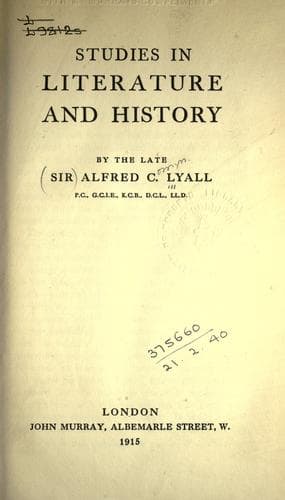
Studies in Literature and HistoryLyall, Alfred C., Sir
Religion
Studies in Literature and History
Lyall, Alfred C., Sir
English literature; History; Literature; Religion; Utilitarianism
matter of sheltering a guest, is shown in the ballad which relates how
a son killed his father for violating this law of hospitality. Like
all popular verse, the Afghan songs have their recurrent phrases and
familiar commonplaces; yet, says Darmesteter,
'in spite of the limited range of ideas and interests, and a rather
low ideal, all such defects find their excuse in the passion, the
simplicity, the direct spontaneous outspeaking, that supreme gift
which has been lost in our intellectual decadence.'
The stirring events of the time have been immediately put into verse;
the scenes and feelings are struck off in the die of actual
circumstance; the heated metal takes a clear-cut impression. It is in
rough songs like these that are to be found the germs of the higher
heroic poetry. The ballad, the short stories, the favourite anecdotes
of remarkable men at their exploits, have the luck to fall, later,
into the hands of a skilful reciter or verse-maker; they are enlarged,
knit together, and fashioned according to the ideas of the day, with
an infusion of rhetoric and literary decoration. The heroic ideal, to
use Professor Ker's words, is thus worked up out of the sayings and
doings of great men of the fore-time, who stand forth as the type and
embodiment of the virtues and vices of their age, as it was conceived
by poets who could handle the popular traditions. And we may guess
that all anecdotes, words of might, and feats of arms that were
current before and after him, if they were appropriate to the type,
would cluster round the hero, and be used for bringing his character
into strong relief. We can even discern this tendency in modern
society, where a notable personage, like the Duke of Wellington or
Talleyrand, is credited with any vigorous or caustic saying that suits
the idea of him, and may be passed on in another generation to the
account of the next popular favourite. The literary habit of providing
impressive 'last words' for great men at death's door might be taken
as another example of the magnetic attraction of types.
Of course the perfect samples of heroic verse, of famous songs and
stories woven into an epic poem, are to be found in Homer.[17]
Nowhere, in the whole range of the world's poetry, can we see such
splendid impersonations of primitive life and character treated
artistically. Yet the plot is simple enough. Agamemnon, the chief
commander of the Greek army, has carried off the daughter of a priest
of Apollo, and flatly refuses to give her back; whereupon the priest
appeals to the god, who brings the chief to reason by spreading a
plague in the Grecian camp; and so the girl goes home with apologies.
But Agamemnon indemnifies himself by seizing a captive damsel
belonging to Achilles, who, being justly infuriated, will go no more
to battle, but sits sulkily in his tent, until the Greek army is very
nearly destroyed, for want of his help, by the Trojans.
Public-domain text, read in full here on John Shaqi.
Reviews
Reviews
No reviews yet
Be the first to share your thoughts on this work.
Elsewhere in the archive
Join the Discussion
Join the discussion
Sign in to leave a comment or review.
Sign InorCreate an account