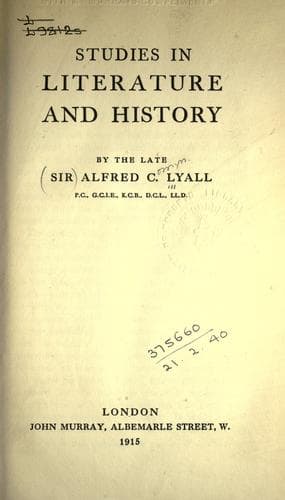
Studies in Literature and HistoryLyall, Alfred C., Sir
Religion
Studies in Literature and History
Lyall, Alfred C., Sir
English literature; History; Literature; Religion; Utilitarianism
That a master of this art must have been very rare is shown by the
very few pieces of first-class heroic poetry still extant out of the
immense quantity that must have been attempted in different ages and
countries. Yet the materials lie strewn around us, awaiting the
skilful hand; they are to be found wherever a high-spirited warlike
race is fighting its way upward out of barbarism into some less
wretched stage of society that may allow breathing time for working
the precious mines of recent traditions. The state of society
described in some Icelandic Sagas, for example, with its hereditary
blood feuds and perpetual assassinations, with its code of honour
making vengeance a pious duty, its tariff of blood money, and its
council for adjusting civil and criminal wrongs, has a close
resemblance to everyday life among the free Afghan tribes beyond the
North-West Frontier of India. But the Saga writers flourished, I
understand, when this state of things had passed or was passing away;
while the Afghans are still a rude illiterate folk who have only
songs, recited by the professional bards. The best collection of these
popular songs has been made by a Frenchman, the late James
Darmesteter, who remarks that 'English people in India care little for
Indian songs'; though one may reply that he has made use of English
writers and collectors of frontier folklore, and indeed he
acknowledges his debt to Mr. Thorburn's excellent book on _Bannu or
our Afghan Frontier_. However that may be, we have here, in these
unwritten lays, the stuff out of which is developed, first, the
established tradition, and, secondly, not only poetry but also the
beginnings of history, for these lays are the oral records of
contemporary events--'c'est le cri meme de l'histoire.' They tell of
the last Afghan War, and of the most famous border forays made by the
English lords on the Afghan marches: they preserve the names and deeds
of English officers and of the leading warriors of the Afghan tribes:
they tell how Cavagnari 'drank the stirrup-cup of the great journey'
when the English mission was slaughtered at Kabul in 1879, and how
General Roberts, his heart shot through with grief, set out in fiery
speed on his avenging march against the Afghan capital. Here then is
for the modern historian a rare opportunity of comparing the
contemporary popular version of events with exact authentic official
record; and the result ought to aid him in deciding, by analogy, what
value is to be placed on similar material that has been handed down
in the ancient songs and stories of other countries. He will be
fortified, I think, in the sound conclusion that all far-sounding
legend has a solid substratum of fact. As poetry, these songs render
forcibly the temper and feelings of the people; they illustrate their
virtues and vices, their worship of courage and devotion to the clan,
their fanaticism and ferocity. The sense of Afghan honour, in the
Public-domain text, read in full here on John Shaqi.
Reviews
Reviews
No reviews yet
Be the first to share your thoughts on this work.
Elsewhere in the archive
Join the Discussion
Join the discussion
Sign in to leave a comment or review.
Sign InorCreate an account