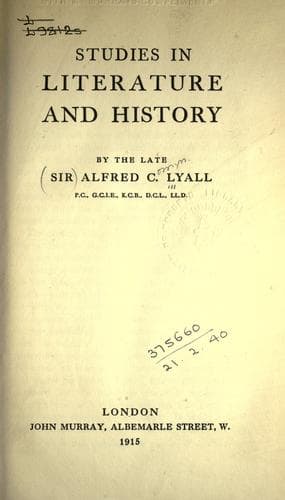
Studies in Literature and HistoryLyall, Alfred C., Sir
Religion
Studies in Literature and History
Lyall, Alfred C., Sir
English literature; History; Literature; Religion; Utilitarianism
It may be allowable to suggest, therefore, among the reasons for the
prevailing dearth and scarcity of first-class heroic poetry,
notwithstanding the universal demand for it, the impossibility of thus
handling war on a great scale, and also the serious difficulty of
giving this poetic form to contemporary events, which are not easily
grouped in artistic perspective because they are so accurately
described elsewhere. This suggestion may derive support from the
observation that whenever, in our own day, we have had brief samples
of verse-writing with a strain of the genuine old quality, they have
almost always come from a distant scene, usually from the frontiers of
the British Empire, far away from the centres of academic culture and
the fields of organised war. Two or three of Rudyard Kipling's short
poems about life on the Afghan border and Indian camp life have the
right ring: they are instinct with the colour and sensation of the
environment: they stir the blood with a conviction of reality. If it
be permissible for a moment to compare these rough energetic verses
with the battle pieces of an immeasurably greater artist--with
Tennyson's _Charge of the Light Brigade_, for example--one may see
that in the poetry of action the grand style misses something which
has been caught by the eye that has seen the thing itself; the Charge
is a splendid composition, but the frontier ballad sets you down on
the ground and shows you life.
Undoubtedly, also, the romantic literary style, which prevailed so
long in this country, and which is the natural product of high
culture, has been unfavourable, because it was radically unsuitable,
to the poetry of energetic action. It is true that all the highest
compositions of the heroic poet are set off by a tinge of romance, as
fine drawing is perfected by superb colouring; but the drawbacks of
romance lie in a tendency to vagueness of thought, and to the
preference of archaic words and overstrained sentiments which were
given as poetic mainly because they were far-fetched and did not sound
commonplace. In fact the later poets adopted mechanically the strong
natural language of those who wrote under the inspiration of actual
emotion or events, and therefore they used it awkwardly and
ineffectively; or else in their consciousness of not knowing how
things really happened, they kept within sonorous generalities, which
are the resource of artistic impotence. In our own day we have
witnessed a sharp revolt against romantic verse, and a reversion
toward those forms of art which reflect the actual experience of men,
toward precision and accurate detail: Romance has been abandoned for
what is called Realism. But here we are threatened by a danger from
the opposite direction: for a clumsy Realist is apt to suppose that
his business is merely to describe facts without adding anything out
of his own imaginative faculty, that he may bring his characters on
the stage in their daily garb, in the dirty slovenliness with which
Public-domain text, read in full here on John Shaqi.
Reviews
Reviews
No reviews yet
Be the first to share your thoughts on this work.
Elsewhere in the archive
Join the Discussion
Join the discussion
Sign in to leave a comment or review.
Sign InorCreate an account