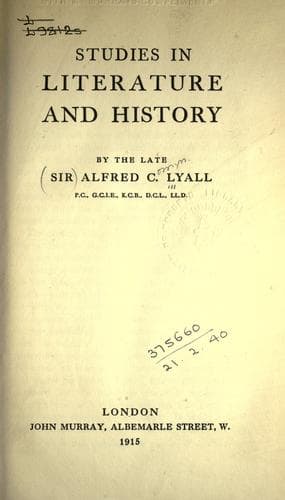
Studies in Literature and HistoryLyall, Alfred C., Sir
Religion
Studies in Literature and History
Lyall, Alfred C., Sir
English literature; History; Literature; Religion; Utilitarianism
they go about dreaming or acting in their own petty sphere,[23] and so
he overcharges with technicalities or trivial particulars.
Nevertheless one may say that the poetry of action has found better
methods since it shook off the influence of fantastic romance, and is
distinctly improving: though its strength lies in short pieces
repeating some notable incident or dramatic situations bringing out
character, which is just where it began originally, and where indeed
it is likely to remain, for the epic poem, or heroic verse on the
grand scale, may be thought to have disappeared finally.
To conclude a very brief and inadequate dissertation, we may, I think,
lay it down as a principle of the art, that heroic poetry must be true
to circumstances and to character, must have the qualities of
simplicity and sincerity, combined with the magnetic power of stirring
the heart by showing how men and women can behave when really
confronted by danger, death, or irremediable misfortune. Its
background, in skilful hands, is the contrast of calm Nature looking
on at human strife and sorrow, at stern fortitude and energetic effort
in tragic situations. We are reading every day of such situations in
the South African War, where there has been no lack of brave men 'so
tried and yet so true,' who have found themselves back again suddenly
in the rough fighting world of their forefathers, and have felt and
acted like the men of old time. There is abundant proof that the
English folk can display as much heroism as ever men did; but we may
look in vain for the poet who knows how to commemorate their valour
and patriotic self-sacrifice in heroic verse.
FOOTNOTES:
[16] _Anglo-Saxon Review_, June 1900.
[17] _Epic and Romance_, p. 15.
[18]
'Ay Espana
Perdita por un gusto y por La Cava.'
_Romance del Rey Rodrigo._
[19]
So doth a woman weep, as her husband in death she embraces,
Him, who in front of his people and city has fallen in battle,
Striving in vain to defend his home from the fate of the vanquished.
She there, seeing him die, and gasping his life out before her,
Clings to him bitterly moaning. And round her the others, the foemen,
Beat her, and bid her arise, and stab at her back with the lances,
Dragging her off as a slave to the bondage of labour and sorrow.
_Odyssey_, viii. 523-29.
[20] _Iliad_, vi. 86-90.
[21] Arnold's translation.
[22] _Iliad_, xix. 228-29.
[23] Lessing.
THE WORKS OF LORD BYRON[24]
Public-domain text, read in full here on John Shaqi.
Reviews
Reviews
No reviews yet
Be the first to share your thoughts on this work.
Elsewhere in the archive
Join the Discussion
Join the discussion
Sign in to leave a comment or review.
Sign InorCreate an account