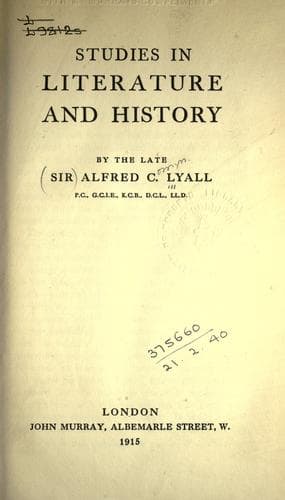
Studies in Literature and HistoryLyall, Alfred C., Sir
Religion
Studies in Literature and History
Lyall, Alfred C., Sir
English literature; History; Literature; Religion; Utilitarianism
In regard to the effect upon his personal reputation, we have long
known what manner of man was Byron; nor is it likely that, after
passing in review the complete array of evidence collected in these
volumes, the general verdict of posterity will be sensibly modified.
Those who judge him should bear in mind that perhaps no famous life
has ever been so thoroughly laid bare, or scrutinised with greater
severity. The tendency of biographers is to soften down errors and
praise where they can; and in an autobiography the writer can tell his
own story. But the assiduous searching out and publication of every
letter and diary that can be gathered or gleaned is a different
ordeal, which might try the reputation of most of us; while in the
case of an impulsive, wayward, high-spirited man, exposed to strong
temptations, with all a poet's traditional irritability, whose rank
and genius concentrated public attention on his writings from his
early youth, this test must be extremely severe. Many of the letters
are of a sort that do not ordinarily appear in a biography. Byron's
letters to his wife at the time of their separation, which are
moderate and even dignified, are supplemented by his wife's letters to
him and to her friends, full of mysterious imputations; and there are
letters to and from the lady with whom his _liaison_ was notorious.
His own reckless letters from Venice to Moore, and those from Shelley
and others describing his dissipated habits, were clearly never
intended for general reading after his death. Of course most of these
are not now produced for the first time, nor do we argue that they
ought never to have appeared, for the biographical interest is
undeniable. Our point is that the publication of such private and
damaging correspondence is so very unusual in biographies that it
places Byron at a special disadvantage, and that when we pass our
judgment upon him we are bound to take into account the unsparing use
that has been made of papers connected with the most intimate
transactions of a lifetime which was no more than a short and stormy
passage from youth to manhood; for he was cut off before the age at
which men abandon the wild ways of their springtide, and are usually
disposed to obliterate the record of them. At least one recent
biography might be mentioned which would have read differently if it
had been compiled with similar candour.
Public-domain text, read in full here on John Shaqi.
Reviews
Reviews
No reviews yet
Be the first to share your thoughts on this work.
Elsewhere in the archive
Join the Discussion
Join the discussion
Sign in to leave a comment or review.
Sign InorCreate an account