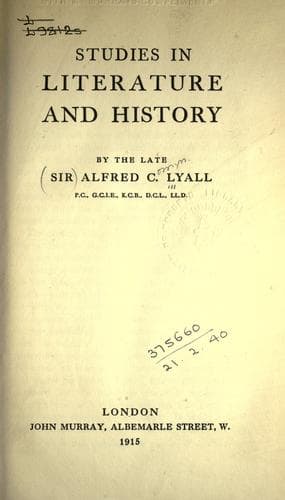
Studies in Literature and HistoryLyall, Alfred C., Sir
Religion
Studies in Literature and History
Lyall, Alfred C., Sir
English literature; History; Literature; Religion; Utilitarianism
The annotations subjoined to almost every page of the text are so
ample and particular as to furnish in themselves extensive reading.
The notices of every person named would go far to serve as a brief
biographical dictionary of Byron's contemporaries, whether known or
unknown to fame. We get a concise account of Madame de Stael--her
birth, books, and political opinions--very useful to those who had no
previous acquaintance with her. Lady Morgan and Joanna Southcote
obtain quite as much space as would be allotted to them in any
handbook of celebrities. Beau Brummell and Lord Castlereagh are
treated with similar liberality. There is a full account, taken from
the _Examiner_, of the procession with which Louis XVIII. made his
entry into London in 1814. The notes--of about four pages each--upon
Hobhouse and Lord Carlisle may be justified by their close connection
with Byron's affairs; though some of us might have been content with
less. Allusions to such notorious evildoers as Tarquin are explained,
and stock quotations from Shakespeare have been carefully verified.
The result is that a reader might go through this edition of Byron
with the very slightest previous knowledge of general literature or of
contemporary history, and might give himself a very fair middle-class
education in the process, although the consequence might be to imbue
him with what Coleridge has called 'a passion for the disconnected.'
Nevertheless we readily acknowledge the thorough execution of this
part of the editorial work, and the very meritorious labour that has
been spent upon bringing together every kind of document and reference
that can inform or enlighten us upon the main subjects of Byron's life
and writings. In the poems the practice of giving in notes the rough
drafts and rejected versions of passages and lines, so as to show the
poet at work, seems to us not altogether fair to him, and is
occasionally distracting to those readers who enjoy a fine picture
without asking how the colours were mixed, or are not anxious about
the secrets of a good dinner. Yet to students of method, to the
fellow-craftsman, and to the literary virtuoso, these variant
readings, of which there are sometimes four to a single line, may
often be of substantial interest, as throwing light on the tendencies
and predilections of taste which are the formative influences upon
style in prose or poetry.
Public-domain text, read in full here on John Shaqi.
Reviews
Reviews
No reviews yet
Be the first to share your thoughts on this work.
Elsewhere in the archive
Join the Discussion
Join the discussion
Sign in to leave a comment or review.
Sign InorCreate an account