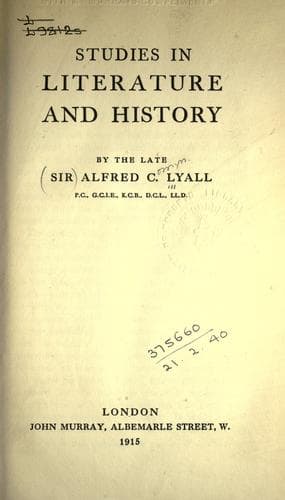
Studies in Literature and HistoryLyall, Alfred C., Sir
Religion
Studies in Literature and History
Lyall, Alfred C., Sir
English literature; History; Literature; Religion; Utilitarianism
poetry has at this moment fallen to a low ebb, and the spell which it
laid upon our forefathers may have lost its power in an altered world.
It must be counted to the credit of these Romantic writers that at any
rate they widened and varied the sphere and the resources of their
art, by introducing the Oriental element, so to speak, into the
imaginative literature of modern Europe. They brought the lands of
ancient civilisation again within the sphere of poetry, reviving into
fresh animation the classic glories of Hellas, reopening the gates of
the mysterious East, and showing us the Greek races still striving, as
they were twenty-two centuries earlier, for freedom against the
barbarous strength of an Asiatic empire. Byron was the first of the
poets who headed this literary crusade for the succour of Christianity
against Islam in the unending contest between East and West on the
shores of the Mediterranean, and in this cause he eventually died.
Chateaubriand, Lamartine, and Victor Hugo were also travellers in
Asia, and had drawn inspiration from that source; they all
instinctively obeyed, like Bonaparte, the impulse which sends
adventurous and imaginative spirits toward that region of strong
passions and primitive manners, where human life is of little matter,
and where the tragic situations of drama and fiction may at any time
be witnessed in their simple reality. The effect was to introduce
fresh blood into the veins of old romance; and Byron led the van of an
illustrious line of poets who turned their _impressions de voyage_
into glowing verse, for the others only trod in his footsteps and
wrote on his model, while Lamartine openly imitated him in his
_Dernier Chant de Childe Harold_. For the first time the Eastern tale
was now told by a poet who had actually seen Eastern lands and races,
their scenery and their cities, who drew his figures and landscape
with his eye on the objects, and had not mixed his local colours by
the process of skimming books of travel for myths, legends, costume,
or customs, with such result as may be seen in Moore's _Lalla Rookh_
and in Southey's _Thalaba_, or even in Scott's _Talisman_. The preface
to this novel shows that Scott fully appreciated the risk of competing
with Byron, albeit in prose, in the field of Asiatic romance, yet all
his skill avails little to diminish the sense of conventional
figure-drawing and of uncertainty in important details when they are
not gathered in the field, but only transplanted from the library.
Byron has noticed in one of his letters the errors of this kind into
which a great poet must fall whose accurate observation has been
confined mainly to his own country. 'There is much natural talent,' he
writes, 'spilt over the _Excursion_, yet Wordsworth says of Greece
that it is a land of
'Rivers, fertile plains, and sounding shores
Under a cope of variegated sky.
Public-domain text, read in full here on John Shaqi.
Reviews
Reviews
No reviews yet
Be the first to share your thoughts on this work.
Elsewhere in the archive
Join the Discussion
Join the discussion
Sign in to leave a comment or review.
Sign InorCreate an account