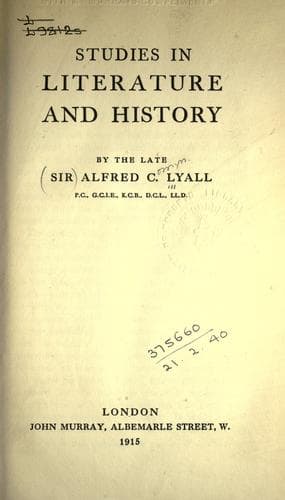
Studies in Literature and HistoryLyall, Alfred C., Sir
Religion
Studies in Literature and History
Lyall, Alfred C., Sir
English literature; History; Literature; Religion; Utilitarianism
Whereas Byron, by stamping his own
character on so much of his verse, created a dangerous interest in the
man himself; and his _empeiria_ (as Goethe calls it), his too
exclusively worldly experience, identified him with his particular
class in society, rendering him largely the responsible representative
of a libertinism in habits and sentiments that was more pardonable in
his time than in our own. His poetry belongs also in another sense to
the world he lived in: it is incessantly occupied with current events
and circumstance, with Spain, Italy, and Greece as he actually saw
them, with comparisons of their visible condition and past glories,
with Peninsular battlefields, and with Waterloo. Of worldliness in
this objective meaning his contemporaries had some share, yet they
instinctively avoided the waste of their power upon it; and so their
finest poetry is beautiful by its detachment, by a certain magical
faculty of treating myth, romance, and the mystery of man's
sympathetic relations with universal Nature.
A recent French critic of Chateaubriand, who defines the 'romantisme'
of that epoch as no more than a great waking up of the poetic spirit,
says that the movement was moral and psychological generally before it
spread into literature. In criticising Byron's poetry we have to bear
in mind that he came in on the first wave of this flood, which
overflowed the exhausted and arid field of poetry at the end of the
last century, fertilising it with colour and emotion. The comparison
between Byron in England and Chateaubriand in France must have been
often drawn. The similarity in their style, their moody, melancholy
outlook upon common humanity, their aristocratic temper, their
self-consciousness, their influence upon the literature of the two
countries, the enthusiasm that they excited among the ardent spirits
of the generation that reached manhood immediately after them, and the
vain attempts of the elder critics to resist their popularity and deny
their genius--form a remarkable parallel in literary history. As
Jeffrey failed at first to discern the promise of Byron, so Morellet
could only perceive the obviously weak points of Chateaubriand, laying
stress on his affectations, his inflated language, his sentimental
exaggeration, upon all the faults which were common to these two men
of genius, the defects of their qualities, the energetic rebound from
the classic level of orderly taste and measured style. It was the
ancient _regime_ contending against a revolutionary uprising, and in
poetry, as in politics, the leaders of revolution are sure to be
excessive, to force their notes, to frighten their elders, and to
scandalise the conservative mind. Yet just as Chateaubriand, after
passing through his period of depression, is now rising again to his
proper place in French literature, so we may hope that an impartial
survey of Byron's verse will help to determine the rank that he is
likely to hold permanently, although the high tide of Romance in
Public-domain text, read in full here on John Shaqi.
Reviews
Reviews
No reviews yet
Be the first to share your thoughts on this work.
Elsewhere in the archive
Join the Discussion
Join the discussion
Sign in to leave a comment or review.
Sign InorCreate an account