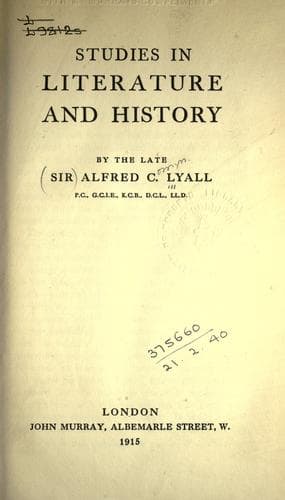
Studies in Literature and HistoryLyall, Alfred C., Sir
Religion
Studies in Literature and History
Lyall, Alfred C., Sir
English literature; History; Literature; Religion; Utilitarianism
In the art of painting what may be called historical landscape, where
retrospective associations give intellectual colour to the picture,
Byron has very few rivals. His descriptions of the Lake of Geneva, of
Clarens, of the Trojan plain--
'High barrows, without marble or a name,
A vast, untilled, and mountain-skirted plain,
And Ida in the distance'--
have the quality of faithful drawing illumined by imaginative power.
They have certainly touched the emotions and enhanced the pleasure of
all travellers in the last three generations whose minds are
accessible to poetic suggestion; and if at the present day their style
be thought too elaborate and the allusions commonplace, it cannot be
denied that the fine art of English composition would be poorer
without them. The stanzas in _Childe Harold_ on Waterloo are full of
the energy which takes hold of and poetically elevates the incidents
of war--the distant cannon, the startled dancers, the transition from
the ball-room to the battlefield, from the gaiety of life to the
stillness of death. Nothing very original or profound in all this, it
may be said; yet the great difficulty of dealing adequately with
heroic action in contemporary verse, of writing a poem on a campaign
that has just been reported in the newspapers, is exemplified by the
fact that Walter Scott's two compositions on Waterloo are failures;
nor has any poet since Byron yet succeeded in giving us a good modern
battlepiece.
Nevertheless there is much in Byron's longer poems (excepting always
_Don Juan_) that seems tedious to the modern reader; there are
descriptions and declamations too long drawn-out to sustain the
interest; and there are many lines that are superfluous, untidy, and
sometimes ungrammatical. One can only plead, in extenuation of these
defects, that the fashion of his day was for long metrical romance, in
which it is difficult to maintain the high standard of careful
composition exacted by the latest criticism. It is almost impossible
to tell a long story in verse that shall be throughout poetical. And
one main reason why this fashion has nearly passed away may be
surmised to be that the versified narrative cannot adapt itself in
this respect to the present taste, which is impatient of fluent
lengthy heroics, refusing to accept them for the sake of some finely
executed passages. Southey's epics are now quite unreadable, and many
of the blemishes in Byron's poetry are inseparable from the romantic
style; they are to be found in Scott's metrical tales, which have much
redundancy and some weak versification; while his chiefs and warriors
often talk a stilted chivalrous language which would now be discarded
as theatrical. Byron's personages have the high tragic accent and
costume; yet one must admit that they have also a fierce vitality; and
as for the crimes and passions of his Turkish pashas and Greek
patriots, he had actually seen the men and heard of their deeds. The
Public-domain text, read in full here on John Shaqi.
Reviews
Reviews
No reviews yet
Be the first to share your thoughts on this work.
Elsewhere in the archive
Join the Discussion
Join the discussion
Sign in to leave a comment or review.
Sign InorCreate an account