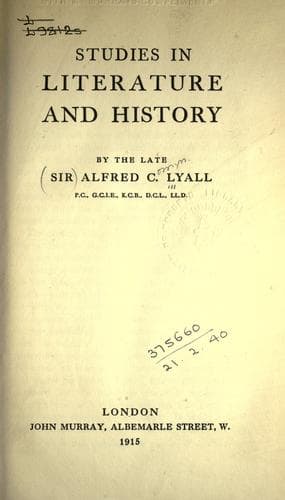
Studies in Literature and HistoryLyall, Alfred C., Sir
Religion
Studies in Literature and History
Lyall, Alfred C., Sir
English literature; History; Literature; Religion; Utilitarianism
fact that he also portrayed more unreal characters in dismal
drapery--Lara, Conrad, and Manfred, as the mouthpieces of splenetic
misanthropy--has led to some unjust depreciation of his capacity for
veritable delineation. Macaulay, for example, in his essay on Byron,
observes that 'Johnson, the man whom Don Juan met in the slave-market,
is a striking failure. How differently would Sir Walter Scott have
drawn a bluff, fearless Englishman in such a situation!' and Mr.
Swinburne echoes this criticism. But it is unfair to compare a minor
character, slightly sketched into a poem for the purposes of the plot,
with the full-length portrait that might have been made of him by a
first-class artist in prose. The proper comparison would be between
the figures in the metrical romances of the two poets, whereby it
might be shown that Scott could take as little trouble as Byron did
about an unimportant subsidiary actor. In regard to the leading heroes
and heroines, Scott's poetic creations are hardly more interesting or
dramatic than Byron's; and whenever he makes, even in prose, an
excursion into Asia, his figure-drawing becomes conventional. But he
was usually at the disadvantage, from which Byron was certainly free,
of being hampered by an inartistic propensity to make virtuous heroes
triumph in the long run.
Yet it must be admitted that no poet of the same calibre has turned
out so much loose uneven work as Byron. His lapses into lines that are
lame or dull are the more vexatious to the correct modern ear when, as
sometimes happens, they spoil a fine passage, and in the midst of a
superb flight his muse comes down with a broken wing. In the subjoined
stanza, for example, from the Waterloo episode in _Childe Harold_, the
first five lines are clear, strenuous, and concise, while the next
three are confused and clumsy; so that though he recovers himself in
the final line, the general effect is much damaged:
'Last noon beheld them full of lusty life,
Last eve in Beauty's circle proudly gay,
The midnight brought the signal-sound of strife,
The morn the marshalling in arms--the day
Battle's magnificently stern array.
The thunder-clouds close o'er it, _which when rent,
The earth is covered thick with other clay,
Which her own clay shall cover_, heaped and pent,
Rider and horse--friend, foe--in one red burial blent.'
Public-domain text, read in full here on John Shaqi.
Reviews
Reviews
No reviews yet
Be the first to share your thoughts on this work.
Elsewhere in the archive
Join the Discussion
Join the discussion
Sign in to leave a comment or review.
Sign InorCreate an account