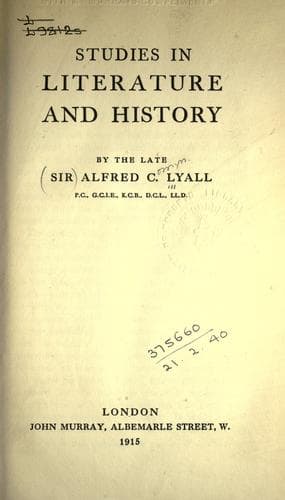
Studies in Literature and HistoryLyall, Alfred C., Sir
Religion
Studies in Literature and History
Lyall, Alfred C., Sir
English literature; History; Literature; Religion; Utilitarianism
are now worn-out theatrical properties; yet those who have seen the
untamed Asiatic might find it hard to overdraw the murderous hate and
sullen ferocity that his face, or his victim's, will occasionally
disclose. The heroes, at any rate, love and die in a masculine way; it
is the old tragic theme of bitter unmerited misfortune, of daring
adventure that ends fatally, without any of the wailing sensuality
that infects the more harmonious poetry of a later day. There are,
perhaps, for modern taste, too many outlandish words and references to
Eastern customs or beliefs, requiring glossaries and marginal
explanations; nor does the profuse annotation of the present edition
lighten a reader's burden in this respect. Byron had no business to
write 'By pale Phingari's trembling light,' leaving us at the mercy of
assiduous editors to expound that 'Phingari' is the Greek [Greek:
phengarion], and stands here for the moon. And if he could have spared
us such Orientalisms as 'Al Sirat's arch,' or 'avenging Monkir's
scythe,' we should have mixed up less desultory reading with the
enjoyment of fine passages. He gives us too much of his local
colouring, he checks the rush of his verse by superfluous metaphors,
he has weak and halting lines. The style is heated and fuming, yet the
dainty art-critic who lays hands on such metal thrown red hot from the
forge may chance to burn his fingers over it. Nor must we forget that
in these poems Byron brought the classic lands of Greece and the
Levant within the sphere of modern romance, and has unquestionably
added some 'deathless pages' to English literature.
Byron has told us why he adopted for the _Corsair_, and afterwards for
_Lara_, 'the good old and now neglected heroic couplet':
'The stanza of Spenser is, perhaps, too slow and dignified for
narrative, though I confess it is the measure after my own heart;
Scott alone, of the present generation, has hitherto triumphed
completely over the fatal facility of the octosyllabic verse; and
this is not the least victory of his fertile and mighty genius; in
blank verse Milton, Thomson, and our dramatists are the beacons
that shine along the deep, but warn us from the rough and barren
rocks on which they are kindled.'[25]
Public-domain text, read in full here on John Shaqi.
Reviews
Reviews
No reviews yet
Be the first to share your thoughts on this work.
Elsewhere in the archive
Join the Discussion
Join the discussion
Sign in to leave a comment or review.
Sign InorCreate an account