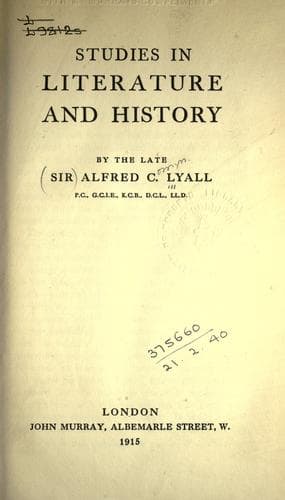
Studies in Literature and HistoryLyall, Alfred C., Sir
Religion
Studies in Literature and History
Lyall, Alfred C., Sir
English literature; History; Literature; Religion; Utilitarianism
have been, did represent a generally prevailing characteristic among
men of excessive sensibility at a time of stir and tumult in the world
around them; it was not a mere unnatural invention, though we must
leave to the psychologist the task of tracing a connection between
this mental attitude and the circumstances that generated it. But the
self-occupied mind has no dramatic power, and so their repertory
contained one single character, a reproduction of their own in
different attitudes and situations. Chateaubriand may be said never to
have dropped his mask; whereas Byron, whose English sense of humour
must have fought against taking himself so very seriously, relieved
his conscience by lapses into epigram, irony, and persiflage. Thus in
the same year (1818), and from the same place (Venice), he produced
the fourth canto of _Childe Harold_, full of deep longing for unbroken
solitude:
'There is a pleasure in the pathless woods,
There is a rapture on the lonely shore,
There is society, where none intrudes,
By the deep sea, and Music in its roar;'
and also _Beppo_, a satirical sketch of the loose and easy Venetian
society in which he was actually living. Here, again, his somewhat
ribald letters from Venice do his romantic poetry some wrong; but in
fact he had a diabolic pleasure in betraying himself, and his
_Memoires d'Outre Tombe_, if they had been preserved, would have been
very different from Chateaubriand's elaborate autobiography.
It was the spectacle of Christians groaning under Turkish oppression,
and of their heroic resistance, that inspired three of Byron's finest
poems, the _Giaour_, the _Bride of Abydos_, the _Siege of Corinth_. On
this subject he was so heartily in earnest that he could even lose
sight of his own woes; and notwithstanding the exuberance of colour
and sentiment, these tales still hold their place in the first rank of
metrical romance. Their construction is imperfect, even fragmentary;
yet while Scott could put together and tell his story much better, not
even Scott could drive it onward and sustain the verse at a high level
with greater energy, or decorate his narrative with finer description
of scenery, or give more intensity to the moments of fierce action.
The splendid apostrophe to Greece in the _Giaour_--
'Clime of the unforgotten brave!
Whose land from plain to mountain cave
Was Freedom's home or Glory's grave'--
has forty lines of unsurpassed beauty and fire, written in the
manuscript, as a note tells us, in a hurried and almost illegible
hand--an authentic example of true improvisation which the elaborate
poets of our own day may match if they can. The tumid phrase and
melodramatic figuring--
'Dark and unearthly is the scowl
That glares beneath his dusky cowl'--
Public-domain text, read in full here on John Shaqi.
Reviews
Reviews
No reviews yet
Be the first to share your thoughts on this work.
Elsewhere in the archive
Join the Discussion
Join the discussion
Sign in to leave a comment or review.
Sign InorCreate an account