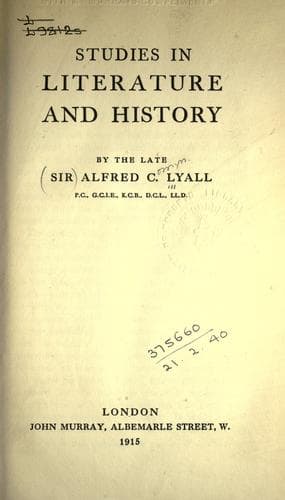
Studies in Literature and HistoryLyall, Alfred C., Sir
Religion
Studies in Literature and History
Lyall, Alfred C., Sir
English literature; History; Literature; Religion; Utilitarianism
Many others of the same quality might be given, in which the
_disjecti membra poetae_ would be exceedingly hard to find. It is
surprising that a writer of Byron's experience should have fallen into
the error of supposing that simplicity could be attained by the mere
use of common language. For even Wordsworth, who is a master of simple
strength, could never allow his peasants to talk their ordinary
vernacular without a fatal drop into the commonplace; and all verse
that is to be plain and unaffected in style and thought requires the
most studious composition. Byron seems scarcely to have understood
that blank verse has any rules of scansion, and his signal failure in
this metre has become less tolerable and more conspicuous, since Keats
in his day, and Tennyson after him, have carefully studied the
construction of blank verse, and have left us admirable examples of
its capacity for romantic expression. It is indeed strange that Byron
should have fancied that he could use so delicate an instrument with a
rough unpractised hand.
There are some vigorous passages scattered through the plays, and we
have it on record that Dr. Parr could not sleep a wink after reading
_Sardanapalus_. Nevertheless, we fear that the present generation will
find little cause for demurring to Jeffrey's judgment upon the
tragedies, that they are for the most part 'solemn, prolix, and
ostentatious.' They were not composed, as Byron himself explained,
'with the most remote view to the stage,' so that he had not before
his eyes the wholesome fear of a critical audience. In truth it must
be admitted that he lacked the true dramatic instinct; he could only
set up his leading figures to deliver imposing speeches appropriate to
a tragic situation; and one may guess that the consciousness of
awkward handling weighed upon the spirit and style of his blank verse,
for his ear seems to have completely misled him when it had lost the
guidance of recurrent rhyme. Of _Cain: a Mystery_, one must speak
reverently, since Walter Scott, to whom it was dedicated, wrote that
the author had 'matched Milton on his own ground'; yet in Lucifer, who
leads the dialogue, we have little more than a spectral embodiment of
Byron's own rebellious temper; and in this poem, as in _Manfred_, the
discussion of metaphysical problems carries him beyond his depth.
There are, nevertheless, some fine declamatory passages; and we may
quote as a curiosity one soft line, fresh from the Swiss mountains:
'Pipes in the liberal air
_Mixed with the sweet bells of the sauntering herd_,'
which is to be found in _Manfred_ and might have been taken from the
_Excursion_.
Public-domain text, read in full here on John Shaqi.
Reviews
Reviews
No reviews yet
Be the first to share your thoughts on this work.
Elsewhere in the archive
Join the Discussion
Join the discussion
Sign in to leave a comment or review.
Sign InorCreate an account