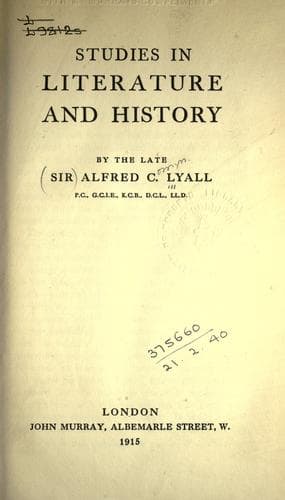
Studies in Literature and HistoryLyall, Alfred C., Sir
Religion
Studies in Literature and History
Lyall, Alfred C., Sir
English literature; History; Literature; Religion; Utilitarianism
When we turn from the plays to the lyrics, we see at once the
importance, to a poet, of choosing rightly the metrical form that is
the best expression of his peculiar genius. In some of these shorter
poems Byron rises to his highest level, and by these will his
popularity be permanently maintained. They are certainly of very
unequal merit; yet when Byron is condemned for artificiality and
glaring colour, we may point to the poem beginning 'And thou art dead,
as young and fair,' where form and feeling are in harmony throughout
eight long stanzas, without a single line that is feeble or
overcharged:
'The better days of life were ours;
The worst can be but mine;
The sun that cheers, the storm that lowers,
Shall never more be thine.
The silence of that dreamless sleep
I envy now too much to weep;
Nor need I to repine
That all those charms have passed away,
I might have watched through long decay.'
There is no novelty in the ideas, nor does he open the deeper vein of
thoughts that touch the mind with a sense of mortality. Yet the verse
has a masculine brevity that renders effectively the attitude in which
men may well be content firmly to confront an irreparable misfortune.
In his poems of strenuous action, although Byron has not the rare
quality of heroic simplicity, he could at times strike a high
vibrating war note, and could interpret romantically the patriotic
spirit. The two stanzas which we quote from the Hebrew Melodies show
that he could now and then shake off the redundant metaphors and
epithets that overload too much of his impetuous verse, and use his
strength freely:
'Though thou art fall'n, while we are free
Thou shalt not taste of death!
The generous blood that flowed from thee
Disdained to sink beneath;
Within our veins its currents be,
Thy spirit on our breath.
'Thy name, our charging hosts along,
Shall be their battle word!
Thy fall, the theme of choral song
From virgin voices poured!
To weep would do thy glory wrong;
Thou shalt not be deplored.'
And we have another magnificent example of Byron's lyrical power in
the _Isles of Greece_, where the two lines,
'Ah, no! the voices of the dead
Sound like a distant torrent's fall,'
drop suddenly into the elegiac strain, into a mournful echo that
dwells upon the ear, followed by the rising note of a call to arms. It
must be remembered that nothing is so rare as a stirring war-song, and
that in our time we have had a good many attempts--almost all
failures; whereas the _Isles of Greece_ will long continue to stir the
masculine imagination of Englishmen.
Public-domain text, read in full here on John Shaqi.
Reviews
Reviews
No reviews yet
Be the first to share your thoughts on this work.
Elsewhere in the archive
Join the Discussion
Join the discussion
Sign in to leave a comment or review.
Sign InorCreate an account