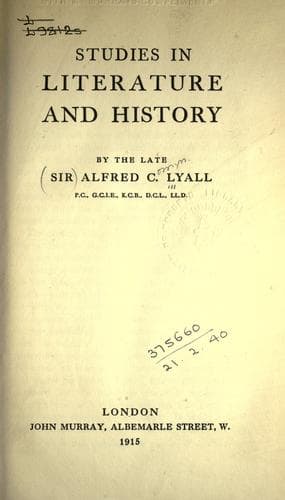
Studies in Literature and HistoryLyall, Alfred C., Sir
Religion
Studies in Literature and History
Lyall, Alfred C., Sir
English literature; History; Literature; Religion; Utilitarianism
Here, in fact, we have the key to Bentham's character, to its weakness
and also to its strength. A philosopher who plunges into the practical
affairs of the world without taking human feelings and imagination
into account is sure to find himself stumbling about among blocks and
blockheads, and tripped up by the ill-will of vested interests; but on
the other hand, if he has taken the right direction, his ardent
energies have the impetus of some natural force. Bentham's earlier
notion had been that political reforms could be introduced like
improvements in machinery; you had only to prove the superior utility
of your new invention to obtain its adoption by all who were concerned
in the business. Latterly he made the surprising discovery that in the
public offices, in the Law, and in the Church, the heads of these
professions are usually quite satisfied with their own monopolies, are
opposed to change, and are always ready with a stock of plausible
arguments to show the folly and danger of innovation. If the
Utilitarian appeals to facts, common sense, and experience, so also
does the Conservative; and until public opinion is decidedly for
progress the dead weight prevails. Not for a day did Bentham relax his
strenuous exertions, but he changed his tactics; he turned from his
mechanical workshop to the study of political dynamics, and he found
what he wanted in the rising radicalism--'his principal occupation, in
a word, was to provide political philosophy for radical reformers.'
Public-domain text, read in full here on John Shaqi.
Reviews
Reviews
No reviews yet
Be the first to share your thoughts on this work.
Elsewhere in the archive
Join the Discussion
Join the discussion
Sign in to leave a comment or review.
Sign InorCreate an account