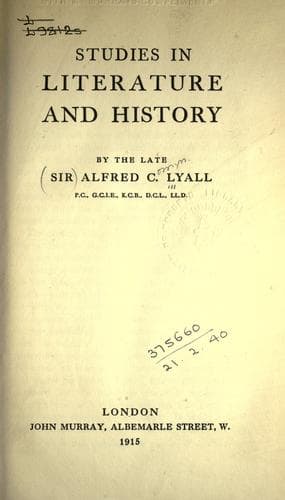
Studies in Literature and HistoryLyall, Alfred C., Sir
Religion
Studies in Literature and History
Lyall, Alfred C., Sir
English literature; History; Literature; Religion; Utilitarianism
The principal events of Bentham's life, and the development of his
opinions, are condensed by Mr. Stephen into one chapter with his usual
biographical skill. Bentham started in life as a barrister, and
attended Blackstone's lectures, with the result that he was deeply
impressed by the fallacies of the legal theories there expounded, and
soon afterward vowed eternal war against the Demon of Chicane. He
struggled against narrow means and obscurity until he made the
acquaintance of Lord Shelburne, through whom he became acquainted with
other leading statesmen, and with Miss Caroline Fox, to whom he made a
futile proposal of marriage some years later. At Bowood he also met
Dumont, and thereby formed his connection with the French jurists,
though in his old age he declared that Dumont, his chief interpreter
abroad, 'did not understand a word of his meaning'; the true cause of
his quarrel being that Dumont criticised Bentham's dinners. He
travelled on the Continent, and lived some time in Russia. Soon
afterward the Revolution made a clean sweep of all the old
institutions in France, and thus laid open a bare and level ground
just suited, as Bentham thought, for an architect who had his
portfolio full of new administrative plans. It was long, indeed,
before he could understand why systematic reforms were not immediately
accepted as soon as their utility was logically demonstrated. He lost
no time in providing the French National Assembly with elaborate
schemes for the reconstruction of various departments of government,
and he even offered to go to France to set up his model prison,
proposing himself 'to become gratuitously the gaoler thereof.' The
Assembly requited his zeal by conferring on him the title of a French
citizen; but social reorganisation took the shape of September
massacres and the Reign of Terror, whereat Bentham was disgusted,
though in no way disheartened, as a theorist.
'Never' (says Mr. Stephen) 'was an adviser more at cross purposes
with the advised. It would be impossible to draw a more striking
portrait of the abstract reasoner, whose calculations of human
motives omit all reference to passion, and who fancied that all
prejudice can be dispelled by a few bits of logic.'
Public-domain text, read in full here on John Shaqi.
Reviews
Reviews
No reviews yet
Be the first to share your thoughts on this work.
Elsewhere in the archive
Join the Discussion
Join the discussion
Sign in to leave a comment or review.
Sign InorCreate an account