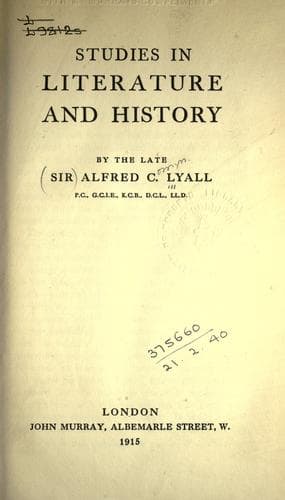
Studies in Literature and HistoryLyall, Alfred C., Sir
Religion
Studies in Literature and History
Lyall, Alfred C., Sir
English literature; History; Literature; Religion; Utilitarianism
Hume's mission was to undermine settled fallacies, and to scatter
doubt among conventional certitudes; and this loosening of foundations
prepared the way for a bolder political projector, who delivered his
frontal attack in disdain of the philosopher's warnings. Political
projectors, says the cautious Hume, are pernicious if they have power,
and ridiculous if they want it. Bentham was quite confident that if he
could only get the power he could radically change for the better the
circumstances of a people in any part of the world, by legislation on
the principles of Utility; and he was sure that character is
indefinitely modifiable by circumstances. That human nature is
constantly altering with, and adapting itself to, the environment, is
an undeniable truth; but in the moral as in the physical world the
natural changes occupy long periods, and to stir the soil hastily may
produce a catastrophe. The latter result actually followed in France;
while in England the doctrine of the unlimited power of legislation,
to be used for the greatest happiness of the greatest number, and
wielded by a sovereign State according to the dictates of public
opinion, was met by alarm, suspicion, and protracted opposition. It
is the habit of Englishmen to admit no proposition, however clear and
convincing, until they discover what the propounder intends to do with
it. Yet it will be seen that Bentham's plans of reform, if not his
principles, did suggest, and to some extent shape, the main direction
of judicial and administrative changes during the nineteenth century,
though with some consequences that he neither anticipated nor desired.
He thought that the State might be invested with power to modify
society, and yet might be strictly controlled in the exercise of that
power. He might have foreseen, what has actually happened, that the
State, once established on a democratic basis, would exercise the
power and disregard his carefully drawn limitations. A tendency toward
State Socialism he would have detested above all things; and yet that
is the direction inevitably taken by supreme authority when the
responsibility for the greatest happiness of the greatest number is
imposed upon it by popular demand.
Public-domain text, read in full here on John Shaqi.
Reviews
Reviews
No reviews yet
Be the first to share your thoughts on this work.
Elsewhere in the archive
Join the Discussion
Join the discussion
Sign in to leave a comment or review.
Sign InorCreate an account