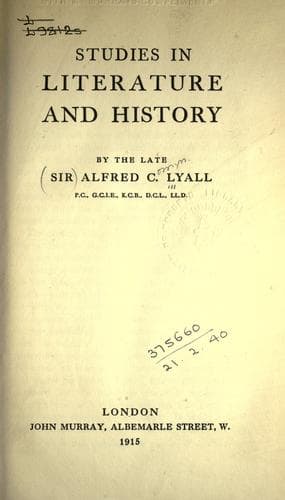
Studies in Literature and HistoryLyall, Alfred C., Sir
Religion
Studies in Literature and History
Lyall, Alfred C., Sir
English literature; History; Literature; Religion; Utilitarianism
Mr. Stephen's second volume describes the later phase of the
Utilitarian creed, when it passed from its founder into the hands of
ardent disciples. The transition necessarily involves some divergence
of views and methods. In religious movements it usually begins after
the founder's death; but as Bentham lived to superintend his apostolic
successors, his relations with them were not invariably harmonious.
The leadership fell upon James Mill, whose early life and general
character, the development of his opinions, and the bearing of his
philosophy upon his politics, are the subjects of one of those
condensed biographical sketches in which Mr. Stephen excels. In the
_History of India_, which brought to James Mill reputation and
pecuniary independence, he could apply his deductive theories to a
remote and little known country without much risk of contradiction
from actual circumstances or of checks from the misapprehension of
facts. In England the Utilitarian doctrines, as propounded in Mill's
writings, raised up opposition and hostile criticism from various
quarters. The general current of ideas and feelings had now set
decidedly toward the suppression of inveterate abuses, and toward
constitutional reform. Radicalism was gaining ground rapidly, and even
Socialism had come to the surface, while Political Economy was in the
ascendant. But the old Tories closed their ranks for a fierce
resistance against theories that menaced, as it seemed to them,
nothing less than destruction to time-honoured institutions; and the
Whigs had no taste for doctrines that pretended to be reasonable, but
appeared to them in effect revolutionary. The different positions of
contending parties were illustrated, as Mr. Stephen shows, by their
respective attitudes towards Church Reform. The Tories defended
ecclesiastical establishment as one of the main bastions of the
citadel; the Whigs would preserve the Church in subjection to the
State; while James Mill, in the _Westminster Review_, declared the
Church of England to be a mere State machine, worked in subservience
to the sinister interest of the governing classes. He desired 'to
abolish all dogmas and ceremonies, and to employ the clergy to give
lectures on ethics, botany, and political economy, with decent dances
and social meals for the celebration of Sunday.' Mr. Stephen, after
observing that this plan exemplifies 'the incapacity of an isolated
clique to understand the real tone of public opinion,' adds that 'it
seems to have some sense, but one would like to know whether Newman
read his article.' Our own notion would be that it is a signal
instance of shortsightedness and of insensibility, on the part of a
psychologist, to the strength and persistence of one of the most
powerful among the emotions that dominate mankind. Mill's article
proclaiming these views appeared in 1835, just at the time when the
Oxford Movement was stirring up a wave of enthusiasm for the dogmas
Public-domain text, read in full here on John Shaqi.
Reviews
Reviews
No reviews yet
Be the first to share your thoughts on this work.
Elsewhere in the archive
Join the Discussion
Join the discussion
Sign in to leave a comment or review.
Sign InorCreate an account