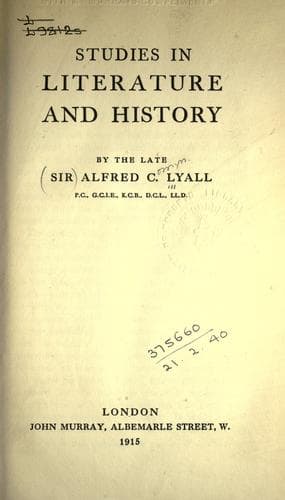
Studies in Literature and HistoryLyall, Alfred C., Sir
Religion
Studies in Literature and History
Lyall, Alfred C., Sir
English literature; History; Literature; Religion; Utilitarianism
Both parties, in fact, appealed to experience; but Peel took his stand
upon history, which the Utilitarians disregarded as a mere record of
unscientific errors, or at most as a lighthouse to give warning of
rocks, rather than a lamp to show the road ahead. And the point upon
which they joined issue was as to the consequences of staking the
whole fabric of government upon the basis of public opinion, operating
through almost unlimited popular suffrage. The Tory foretold that
this would end in wrecking the Constitution, with the ship among
breakers, and steering by ballot voting. The Benthamite persuaded
himself that enlightened self-interest, empirical perceptions of
utility, and general education, would prevail with the multitude for
their support of a rational system. But with those who demanded
sovereignty for the people a strict limitation of the sphere of
government was one essential maxim; and the Utilitarians would have
agreed with Guizot when he declared it to be 'a mere commonplace that
as civilisation and reason progress, the sphere of public authority
contracts.' They do not appear to have foreseen that whenever the
masses should have got votes legislation would become democratic, or
even socialistic, in order to capture them. This discovery was
eventually made by the Tories, who availed themselves of it to dish
the Whigs, and to come forward again upon a popular suffrage as the
true friends and guardians of the people.
In Mr. Stephen's second volume James Mill is the principal figure, as
the apostle of Benthamism, though he also describes briefly, in his
terse and incisive style, the lives and opinions of some notable men,
foes as well as friends to the party, who represented different
expressions of energetic protest against existing institutions. To
each of them is allotted his proper place in the line of attack, and
his due share in the general enterprise of rousing, by argument or
invective, the slow-thinking English people to a sense of their
lamentable condition. Cobbett and Owen were at feud with true
Utilitarians, and in unconscious alliance, against the orthodox
economists, with the Tories, who, as we have said, have eventually
found their advantage in the democratic movement. Cobbett fought for
the cause of the agricultural labourer, trodden under foot by squires
and parsons. Owen believed that the grasping capitalist, with his
steam machinery, would further degrade and impoverish the working
classes. Godwin, who is merely mentioned by Mr. Stephen, was a
peaceful anarchist, who proposed 'to abolish the whole craft and
mystery of government,' to abandon coercion and rely upon just
reasoning, upon the enlightened assent of individuals to the payment
of taxes. They all embodied ideas that are incessantly fermenting in
some ardent minds, and that maintain a perceptible influence on
political controversies at the present day. Godwin agreed with the
Utilitarians that government is a bad thing in itself, but he went
Public-domain text, read in full here on John Shaqi.
Reviews
Reviews
No reviews yet
Be the first to share your thoughts on this work.
Elsewhere in the archive
Join the Discussion
Join the discussion
Sign in to leave a comment or review.
Sign InorCreate an account