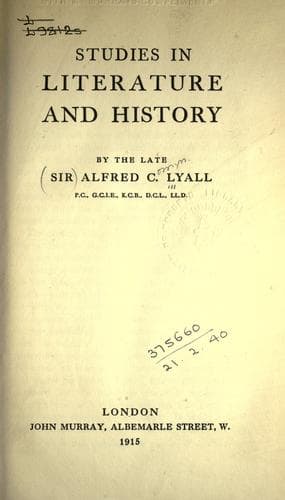
Studies in Literature and HistoryLyall, Alfred C., Sir
Religion
Studies in Literature and History
Lyall, Alfred C., Sir
English literature; History; Literature; Religion; Utilitarianism
'The two great rival theories of the functions of the State
are--the theory which was for so many years dominant in England,
and which may for convenience be called the Individualist theory;
and the theory which is stated most fully and powerfully by the
Greek philosophers, which we may call the Socialist theory. The
Individualist theory regards the State as a purely utilitarian
institution, a mere means to an end.... It represents the State as
existing mainly for the protection of property and personal
liberty, and as having therefore no concern with the private life
and character of the citizen, except in so far as these may make
him dangerous to the material welfare of his neighbour.
'The Greek theory, on the other hand, though it likewise regards
the State as a means to certain ends, regards it as something
more.... According to this theory, no department of life is outside
the scope of politics; and a healthy State is at once the end at
which the science aims, and the engine by which its decrees are
carried out.'[29]
Accepting this passage as a philosophical statement of tendencies, we
may observe that neither theory has ever been definitely adopted in
England. The Utilitarians desired to recast institutions for the
greater happiness of all citizens, but they were averse to investing
the State with autocratic powers of interference. The Tories, on the
other hand, were awakening to the conviction that the Government must
do more for the people; but their fear of change and their own
'sinister interests,' persuaded them that this might be done without
radical reforms. The Whigs faced both ways, and since in England the
truly valuable effect of extreme opinions is always to drive the
majority into a middle course, they rose to power on that compromise
which is represented by the Reform measures of 1832. The Reform Bill
was accepted by the Utilitarians as an instalment of the rightful
authority of the people over the conduct of public affairs, and
therefore a provisional method of promoting their welfare. The first
Tory statesman of that day, on the contrary, was convinced that for
the public welfare the existing Constitution could not be bettered:
'During one hundred and fifty years the Constitution in its present
form has been in force; and I would ask any man who hears me to
declare whether the experience of history has produced any form of
government so calculated to promote the happiness and secure the
liberties of a free and enlightened people.'[30]
Public-domain text, read in full here on John Shaqi.
Reviews
Reviews
No reviews yet
Be the first to share your thoughts on this work.
Elsewhere in the archive
Join the Discussion
Join the discussion
Sign in to leave a comment or review.
Sign InorCreate an account