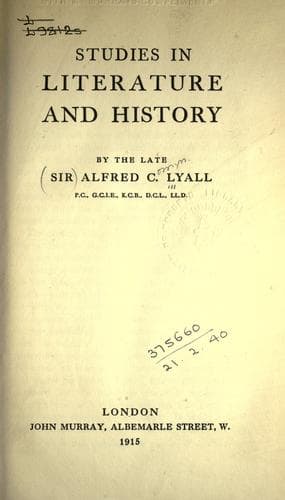
Studies in Literature and HistoryLyall, Alfred C., Sir
Religion
Studies in Literature and History
Lyall, Alfred C., Sir
English literature; History; Literature; Religion; Utilitarianism
'"I am convinced," said Edward, "that you really feel all the
delight in a fair prospect which you profess to feel. But, in
return, your sister must allow me to feel no more than I profess. I
like a fine prospect, but not on picturesque principles; I do not
like crooked, twisted, blasted trees. I admire them much more if
they are tall, straight, and flourishing. I do not like ruined,
tattered cottages. I am not fond of nettles or thistles or heath
blossoms. I have more pleasure in a snug farm-house than a
watch-tower, and a troop of tidy happy villagers please me better
than the finest banditti in the world."'[5]
There can be no doubt, indeed, that in the novels of this period two
main features of the modern story, the word-painting of scenery and
the analysis of subjective emotions, are conspicuously absent. Yet
among the manifold causes to which may be ascribed the wide recent
expansion of the Novel of Manners, we may well reckon the decisive
impulse that it received from these famous authoresses. They were, in
fact, the founders of the dominion which women bid fair to establish
over this class of fiction, where they are already extending it to a
degree that threatens to evict the men. Various circumstances have
co-operated toward this curious literary revolution. The conventional
romance, though apparently flourishing, was in their time on the brink
of a decline; and as women have never succeeded in the Novel of
Adventure--for the obvious reason that their tastes and experiences
are opposed to success--they had no difficulty in abandoning a
decaying school, and in throwing all their freshness of mind and
subtlety of observation into the department which precisely suited
their idiosyncrasy. The spread of education among female readers and
writers has undoubtedly aided them. And thus the rise of feminine
novelists has operated as a formidable contingent of fresh troops that
has joined the camp of Manners, to which alliance it may be noticed
that, with very few exceptions, the women have faithfully adhered. For
although in the last century Mrs. Radcliffe had revived, as Mr.
Raleigh observes, the Romance proper, and Miss Jane Porter claimed in
the first years of this century the honour of having invented the
historical romance, women have been practically superseded in this
class of literature, so far as it survives, by men, George Eliot's
_Romola_ being the only notable exception. The true representatives of
female novelists are now the leaders of that school which confines
itself to minute observation, whether of outward facts or inward
feeling, and which is above all things devoted to the close
delineation of contemporary society. The analysis of character within
the range of ordinary experience, the play of civilised emotion, the
vicissitudes of grief or joy in the parsonage, the ball-room, and the
village, the troubled course of legitimate love-making, have all
Public-domain text, read in full here on John Shaqi.
Reviews
Reviews
No reviews yet
Be the first to share your thoughts on this work.
Join the Discussion
Join the discussion
Sign in to leave a comment or review.
Sign InorCreate an account