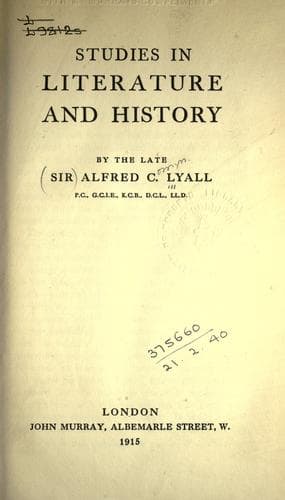
Studies in Literature and HistoryLyall, Alfred C., Sir
Religion
Studies in Literature and History
Lyall, Alfred C., Sir
English literature; History; Literature; Religion; Utilitarianism
It was the philosophic strategy of J. S. Mill to prosecute the
Utilitarian war against metaphysics, and finally to exterminate
Intuitions, being convinced, as he said, that the _a priori_ and
spiritualistic thinkers still far exceeded the partisans of
experience, and that a great majority of Englishmen were still
Intuitionists. Is this actually a true account of English thought? Mr.
Stephen thinks not, for he believes that if Mill had not lived much
apart from ordinary folk he would have found Englishmen practically,
though not avowedly, predisposed to empiricism, which has been the
philosophic tradition in this country since Hobbes. We so far agree
with Mr. Stephen that we believe Englishmen, in general, to practise a
great deal more of empiricism than they avow. But Mill proposed to
demonstrate and declare it as a weapon in polemics and an engine of
action, and it was here, probably, that the main body of Englishmen
deserted him. They were not ready to cut themselves off from theology
and from all ideas that transcend experience, and they demurred to the
paramount jurisdiction of logic in temporal affairs. To every section
of Churchmen the relegation of moral sanctions within the domain of
verifiable consequences was a doctrine to be resisted strenuously.
With the high sacerdotalist it amounted to a denial of the Christian
mysteries; to the Broad Churchman it was ethically inadequate and
ignoble; to the scholastic professor of divinity it meant ruinous
materialism.
That a vigorous thinker should have begun by striking at what seemed
to him the root of obstructive fallacies was natural enough. He
supposed that a logical demonstration would clear the ground for his
plans of reform; whereas, on the contrary, it entangled him in
preliminary disputations, and his inflexible reasoning alarmed people
who followed experience as the guide of life, but instinctively felt
that there must be something beyond phenomenal existence. In political
economy Mill relied upon common sense and practice in affairs to make
the requisite allowance for general laws founded on human propensities
regarded abstractedly. His conviction was, in short, that nothing
should be taken for granted because everything might be explained; and
he desired to tie men down to accepting no belief, or even feeling,
that could not be justified by reason. His _System of Logic_ was, as
he has himself written, a text-book for the doctrine 'which derives
all knowledge from experience, and all moral and intellectual
qualities principally from the direction given to the associations.'
When he proceeded to construct a systematic psychology upon this
basis, he fell into the fundamental perplexities that are concisely
brought out by Mr. Stephen in his scrutiny of Mill's doctrine of
Causation. He followed Hume in severing any necessary connection
between cause and effect, and even invariable sequence became
incapable of proof. But when he resolved Cause into a statement of
Public-domain text, read in full here on John Shaqi.
Reviews
Reviews
No reviews yet
Be the first to share your thoughts on this work.
Elsewhere in the archive
Join the Discussion
Join the discussion
Sign in to leave a comment or review.
Sign InorCreate an account