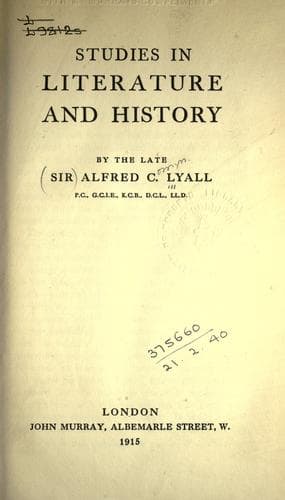
Studies in Literature and HistoryLyall, Alfred C., Sir
Religion
Studies in Literature and History
Lyall, Alfred C., Sir
English literature; History; Literature; Religion; Utilitarianism
existing conditions that can never be completely known until we have
mastered the whole series of physical phenomena, and showed that all
human induction is fallible because necessarily imperfect, it became
clear that Mill had very little to offer in substitution for those
grounds of ordinary belief that he was bent on demolishing. The word
Cause is reduced, for ordinary use, to a signification not unlike that
which is understood in loose popular language by the word Chance,
since Chance means no more than ignorance of how an event came to
pass; and in no case, according to Mill, can we ever calculate with
security what undiscoverable conditions may suddenly bring about an
unexpected event contrary to previous experience. The uniformity of
Nature, as Mr. Stephen remarks, is thus made exceedingly precarious;
and to the practical intelligence, which looks for some basis that
cannot be argued about, there is still something to be said for
Intuition. And when Mill, still in search of some precise formula,
undertook to interpret persistent sequences by his theory of Real
Kinds possessing an indeterminate number of coherent properties--so
that our belief in the invariable blackness of crows is justified as a
collocation of these visible properties--he merely throws the problem
of Causation farther backward. We have to be content with direct
observation of phenomena that can be classified as co-existent; we can
perceive that things accompany each other, but we can never be sure
that they follow each other, as they appear to do.
It may be doubted whether Mill's treatment of these problems has
materially affected subsequent psychological speculation, which has
since taken different and deeper courses. His main objective was
social and political.
'The notion,' he has written, 'that truths external to the mind may be
known by intuition, or consciousness, independently of observation and
experience, is, I am persuaded, in these times the great intellectual
support of false doctrines and bad institutions.' In confounding the
metaphysicians, and eliminating all mysterious assumptions or axioms,
he aimed at clearing the ground for a demonstrable science of
character, and to establish the great principle that character can be
indefinitely modified. The way is thus opened to questions of conduct,
to positive remedies for social and political evils which, as they
have been generated and fostered by external circumstances, can be
removed by a change of those circumstances.
Public-domain text, read in full here on John Shaqi.
Reviews
Reviews
No reviews yet
Be the first to share your thoughts on this work.
Elsewhere in the archive
Join the Discussion
Join the discussion
Sign in to leave a comment or review.
Sign InorCreate an account