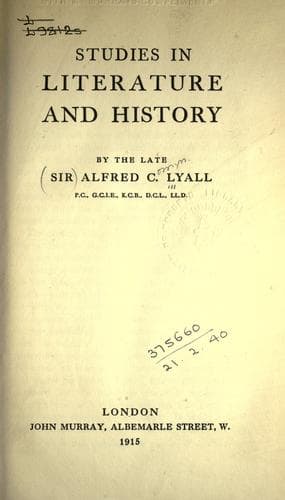
Studies in Literature and HistoryLyall, Alfred C., Sir
Religion
Studies in Literature and History
Lyall, Alfred C., Sir
English literature; History; Literature; Religion; Utilitarianism
'The greatest problems of the time were either economical or
closely connected with economical principles. Mill had followed the
political struggles with the keenest interest; he saw clearly their
connection with underlying social movements; and he had thoroughly
studied the science--or what he took to be the science--which must
afford guidance for a satisfactory working out of the great
problems. The Philosophical Radicals were deserting the old cause,
and becoming insignificant as a party. But Mill had not lost his
faith in the substantial soundness of their economic doctrines. He
thought, therefore, that a clear and full exposition of their views
might be of the highest use in the coming struggle.... The
_Political Economy_ speedily acquired an authority unapproached by
any work published since the _Wealth of Nations_.'
We cannot follow Mr. Stephen through his elaborate and effective
review of this celebrated book. Its appearance marked an epoch in the
history of Utilitarianism, for it took a much wider survey of social
and political considerations, and the author undertook to expand the
orthodox economic theories so that they might embrace and be
reconciled with some daring projects of comprehensive reform. But Mill
had to put some strain on the principles to which he adhered, and to
accommodate certain inconsistencies in order to keep pace with moving
ideas. He held on with some effort to the cardinal tenets of the older
Utilitarians, to a dislike of interference by governments, to
reliance on individual effort, to protest against the deadening
influence of paternal administration, to his own trust in the gradual
effect of educational agencies, and in the slow emancipation of the
popular mind from unreasoning prejudices. On the other hand, he
advocated a radical reform of the land laws, peasant proprietorship,
the acquisition by the State of railways and canals, the limitation of
the right of bequest; and he went even so far as to speak with
approval of laws in restraint of improvident marriages. All these
proposals could only be carried out by arbitrary and drastic
legislation. As he put it, the State must interfere for the purpose of
making the people independent of further interference; and he
overlooked or set aside the question whether the eventual result of
thus calling in the State's agency would not be contrary to the
principles and professed intentions of the Utilitarian school, whether
the provisional _regime_ would not become permanent, as, in fact, it
has been rapidly becoming ever since.
Public-domain text, read in full here on John Shaqi.
Reviews
Reviews
No reviews yet
Be the first to share your thoughts on this work.
Elsewhere in the archive
Join the Discussion
Join the discussion
Sign in to leave a comment or review.
Sign InorCreate an account