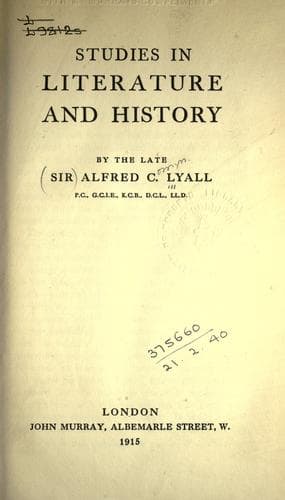
Studies in Literature and HistoryLyall, Alfred C., Sir
Religion
Studies in Literature and History
Lyall, Alfred C., Sir
English literature; History; Literature; Religion; Utilitarianism
Mr. Stephen's criticism of Mill's later writings exhibits further his
difficulties in adjusting the essential Utilitarian principles to
closer contact with the urgent questions of the day. Mill still held
to competition, to the full liberty of individuals, to the inevitable
mechanical working of economic laws; he still doubted the expediency
of factory legislation, and condemned any laws in restraint of usury.
He was opposed, broadly, to all authoritative intrusion upon human
existence wherever its necessity could not be proved conclusively to
be in the interest of a self-reliant community. Yet he was forced to
make concessions and exceptions in the face of actual needs and
grievances; and especially he found himself more and more impelled to
tolerate and even advocate interference by the State as the only
effective instrument for demolishing obstacles to the moral and
material betterment of the people. Since unjust social inequalities
could be traced to an origin in force or fraud, the legislature might
be logically called in to remove them; and as this is manifestly the
revolutionary argument (as embodied, for example, in the writings of
Thomas Paine), it enabled him to join hands with Radicalism in
proposing some very thorough-going measures. 'Landed property in
Europe derives its origin from force;' so the legislature is entitled
to interpose for the reclamation of rights unjustly usurped from the
community; while, as economical science shows that the value of land
rises from natural causes, the conclusion is that the State may
confiscate the unearned increment. But it was not so easy to convince
the hungry mechanic, by rather fine-drawn distinctions, that the
capitalist had a better right to monopolise profits than the landlord;
for the rise of value in manufactured commodities has very complex
causes, some of them superficially natural. So here, again, is a
plausible case of social injustice. Again, it may be affirmed that all
powerful associations, private as well as public, operate in
restriction of individual liberty. You may argue that great industrial
companies are voluntary; the question is whether they are innocuous to
the common weal, and we may add that this point is coming seriously to
the front at the present time. The distinction, as Mr. Stephen
remarks, drawn by the old individualism between State institutions and
those created by private combination is losing its significance; and,
what is more, public bodies are now continually encouraged to absorb
private enterprise in all matters that directly concern the people.
Public-domain text, read in full here on John Shaqi.
Reviews
Reviews
No reviews yet
Be the first to share your thoughts on this work.
Elsewhere in the archive
Join the Discussion
Join the discussion
Sign in to leave a comment or review.
Sign InorCreate an account