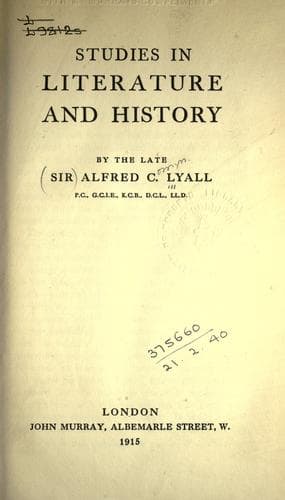
Studies in Literature and HistoryLyall, Alfred C., Sir
Religion
Studies in Literature and History
Lyall, Alfred C., Sir
English literature; History; Literature; Religion; Utilitarianism
In short, we are on the high road to State Socialism, though Mill
helps us to console ourselves with having taken that road on strictly
scientific principles. It is the not unusual result of stating large
benevolent theories for popular application; the principle is accepted
and its limitations are disregarded. Nevertheless Mill contends
gallantly in his later works for intellectual liberty, complete
freedom of discussion, and the utility of tolerating the most
eccentric opinions. Into what practical difficulties and questionable
logical distinctions he was drawn by the necessity of fencing round
his propositions and making his reservations is well known; and Mr.
Stephen hits the weak points with keen critical acumen. We all agree
that persecution has done frightful mischief, at times, by suppressing
the free utterance of unorthodox opinions. But Mill argues that
contradiction, even of truth, is desirable in itself, because a
doctrine, true or false, becomes a dead belief without the
invigorating conflict of opposite reasonings. Resistance to authority
in matters of opinion is a sacred privilege essential to the formation
of belief; wherefore originality, even when it implies stupidity, is
to be carefully protected as a factor of human progress. We need not
follow Mr. Stephen in his victorious analysis of the arguments
wherewith Mill seeks to uphold this uncompromising individualism, and
to guard human perversity against the baneful influence of authority.
It is clear enough that society cannot waste its time in perpetual
wrangling over issues upon which an authoritative verdict has been
delivered; and for most of us a reasonable probability, founded on the
judgment of experts, is sufficient in moral or physical questions as
well as in litigation. The religious arena still remains open, where
experts differ and decisions are always disputable. Yet Mr. Arthur
Balfour devotes a chapter in his _Foundations of Belief_ to the
contention that our convictions on all the deeper subjects of thought
are determined not by reason but by authority; whereby he provides us
with an escape from the scepticism that menaces a philosopher who has
proved all experience to be at bottom illusory. Mill, on the other
hand, would make short work with authority wherever it checks or
discourages the unlimited exercise of free individual inquiry; and in
politics he would entrust the sovereign power to a representation of
the entire aggregate of the community, with the most ample
encouragement of incessant discussion. This is, indeed, the system
actually in force, and in England it has answered very well; but Mill
hardly foresaw that its tendency would be to make the State, as the
embodiment of popular will, not less but more authoritative, with a
tendency to encroach steadily upon the sphere of individual effort and
private enterprise.
Public-domain text, read in full here on John Shaqi.
Reviews
Reviews
No reviews yet
Be the first to share your thoughts on this work.
Elsewhere in the archive
Join the Discussion
Join the discussion
Sign in to leave a comment or review.
Sign InorCreate an account