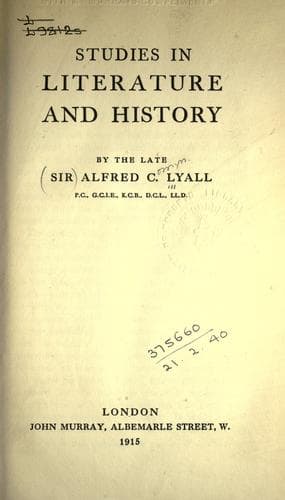
Studies in Literature and HistoryLyall, Alfred C., Sir
Religion
Studies in Literature and History
Lyall, Alfred C., Sir
English literature; History; Literature; Religion; Utilitarianism
It may be said that the abstract Utilitarian doctrine reached its
high-water mark in Mill's book on the Subjection of Women, to which
Mr. Stephen allots one section of a chapter. The book is a particular
enlargement upon Mill's general view that it is a pestilent error to
regard such marked distinctions of human character as sex or race as
innate and in the main indelible. What is called the nature of women
he treats as an artificial thing, an isolated fact which need not at
any rate be recognised by law; the proper test was, he argued, to
leave free competition to determine whether the distinction is radical
or merely the result of external circumstance. But, as Mr. Stephen
answers, such a plain physiological difference is at least not
negligible; and competition between the sexes may favour the despotism
of the stronger, while complete independence on both sides implies
freedom to separate at will; and Mill had only glanced evasively at
the question of divorce. Here, again, is a theory which the pressure
of social conditions, much more than abstract reasoning, is bringing
more and more into prominence with our own generation. On the wider
and more complicated question of race distinctions Mill never worked
out his argument against their indelibility into a regular treatise;
nor could he foresee the increasing influence upon contemporary
politics that is now exercised by racial feelings and their claims to
recognition. In the eighteenth century the French Encyclopedistes, who
were the direct philosophic ancestors of the Utilitarians, regarded
frontiers, classes, and races as so many barriers against the spread
of universal fraternity; and the revolutionary government took up the
idea as a war-cry. The armies of the French Republic proclaimed the
rights of the people in all countries, until Napoleon turned the
democratic doctrine into the form of Imperialism. M. Eugene de Voguee
has told us recently that this armed propaganda produced a reaction in
Europe toward that strong sentiment of nationality which has been
vigorously manifested during the second half of the nineteenth
century. The assertion of separate nationalities, by the demand for
political autonomy and by the attempt to revive the public teaching of
obscure languages, is the form taken in western and central Europe by
the problem of race. No movement could be more contrary to the views
or anticipations of the Utilitarians, for whom it would have been
merely a recrudescence of one of those inveterate and unreasoning
prejudices which still retard human progress, a fiction accepted by
indolent thinkers to avoid the trouble of investigating the true
causes that modify human character. Yet not only is national
particularism making a fresh stir in Europe, but the spread of
European dominion over Asia has forced upon our attention the immense
practical importance of racial distinctions. We find that they signify
real and profound characteristics; the European discovers that in Asia
Public-domain text, read in full here on John Shaqi.
Reviews
Reviews
No reviews yet
Be the first to share your thoughts on this work.
Elsewhere in the archive
Join the Discussion
Join the discussion
Sign in to leave a comment or review.
Sign InorCreate an account