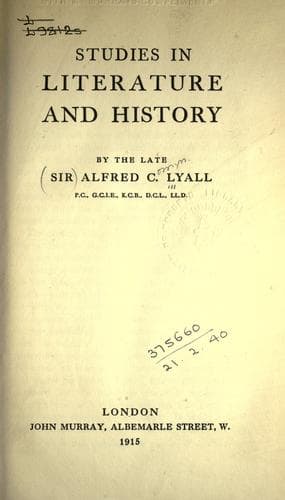
Studies in Literature and HistoryLyall, Alfred C., Sir
Religion
Studies in Literature and History
Lyall, Alfred C., Sir
English literature; History; Literature; Religion; Utilitarianism
Our readers will bear in mind that we are endeavouring to measure the
permanent influence of Utilitarian doctrines, to determine how far
they have fixed the direction, and shaped the ends, of contemporary
thought and political action. It cannot be said that these doctrines
are now predominant in either of these two closely interacting
departments. National instincts and prepossessions have lost none of
their force; national character now divides neighbouring peoples more
sharply, perhaps, than a hundred years ago. Militarism is stronger
than ever; cosmopolitan philanthropy is overridden by the growth of
national interests; political economy is overruled by political
necessities; nor have ethical systems displaced the traditional
religions. Empiricism has fallen into discredit as a narrow and
inadequate philosophy; it is superseded in the spiritual world by
transcendental interpretations of dogmas as metaphysical
representations of underlying realities. Mr. Stephen's most
instructive work draws to its close with a dissertation on Liberalism
and Dogmatism, showing how and why Utilitarianism failed in convincing
or converting Englishmen to a practical assent to its principles and
modes of thought. Upon many minds they produced more repulsion than
attraction. Maurice earnestly protested that we were to believe in
God, not in a theory about God, though the distinction, as Mr. Stephen
says, is vague; he appealed to the inner light, to the conscience of
mankind; he went back into the slough of Intuitionism. Carlyle cried
aloud against materialistic views and logical machinery; he denounced
'the great steam-engine, Utilitarianism'; he was for the able despot
and hero-worship against grinding competition and government by
discussion. In theology the mystical spirit rose again with its
immemorial power of enchanting human imagination; the moral law is
discerned to be the vesture of Divinity, in which He arrays Himself
to become apprehensible by the finite intellect; and a Science that
tries to understand everything explains nothing. Authority, instead of
being discarded, is invoked to deliver men out of the great waters of
spiritual and political anarchy. The Tractarians struck in with a
fierce attack on Rationalism, propounding Faith and Revelation as
imperative grounds of belief. You must accept the dogmas, not as
useful, not as moral or reasonable, not even as derived intuitively,
but as the necessary fundamental truths declared by the infallible
Church to be essential to salvation. Those who could not find
infallibility in a State Church went over to Rome, abandoning the Via
Media; others were content with the high sacramental position of
Anglicanism; the moderate Rationalists took shelter with the Broad
Church; a few retreated into the cloudy refuge of transcendental
idealism. The two extreme parties, the Broad Church and the
Sacerdotalists, were at bitter feud with each other; yet they both
denounced the common enemy.
Public-domain text, read in full here on John Shaqi.
Reviews
Reviews
No reviews yet
Be the first to share your thoughts on this work.
Elsewhere in the archive
Join the Discussion
Join the discussion
Sign in to leave a comment or review.
Sign InorCreate an account